Apple Nvidia GeForce 6800 Ultra DDL--How Fast Is It?
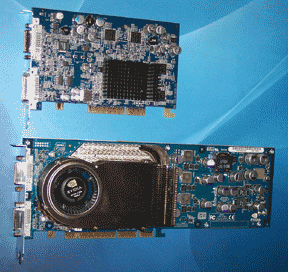 The specifications of the NV6800 Ultra can be found on the Apple Store from a link on the 30" Cinema's web page. The salient part is:
The groundbreaking new NVIDIA GeForce 6800 Ultra delivers the industry's first 16-pipe superscalar architecture and support for the world's fastest DDR3 memory to raise the bar for 3D graphics performance. The specifications of the GeForce 6800 Ultra GPU, are stunning: Using over 220 million transistors it supports a 256-bit interface for an effective memory bandwidth of 35.2 GB per second which delivers 600 million vertices, 6.4 billion textured pixels per second. The GPU is built on an AGP 8X board and includes 256MB of DDR3 memory for use in the most demanding graphics applications. It is the first card available to support the DVI standard dual link digital signal specification from the two DVI ports it features. This capability is required to drive the new 30-inch LCD, high resolution Apple Cinema HD display. The combination of a GeForce 6800 Ultra with a dual processor Power Mac G5 driving two 30-inch Apple Cinema HD Displays is the definitive tool for the creative professional.
The NV6800 Ultra is surprisingly large compared with other modern graphics cards. It is nearly twice as long as the stock ATI Radeon 9600 XT (see photo above right). It is also twice as thick, so it takes up the AGP slot and one of the PCI slots. The flange is two slots wide.
How fast is it? We ran a subset of our usual suite of tests, i.e. those that relate to graphics performance. Our test platform is our new dual 2.5GHz Power Mac G5 which comes standard with an ATI 9600 XT graphics card. The stock 9600 XT is a very nice graphics card that does pretty well at high resolutions because of its 128MB of video RAM as noted in our review of the dual 2.5GHz Power Mac G5. We have used it for a month and it does well with demanding 3D games such as Call of Duty. However, the NV6800 Ultra is on a higher plane with its 16 pipelines and 256MB of DDR3 VRAM.
Here are the results using an original 23" Cinema Display:
| Test |
ATI 9600 XT
|
Nvidia 6800 Ultra
|
Per Cent Improvement
|
|---|---|---|---|
| Mac OS X Version: |
10.3.5
|
10.3.5
|
|
| Canned Benchmarks: | |||
|
Cinebench 2003 - Rendering
|
638
|
639
|
+0
|
|
- OpenGL Hardware Lighting
|
1594
|
1520
|
-5
|
| Let1kWindowsBloom 1.0 (sec) |
34
|
11
|
+68
|
| Xbench 1.1.3 | |||
| - Quartz Graphics |
325
|
302
|
-7
|
| - OpenGL Graphics |
196
|
215
|
+10
|
| - User Interface Graphics |
407
|
377
|
-7
|
| "Real World" Tests: |
--
|
--
|
--
|
| Scroll 142p Acrobat Reader File (sec) |
13
|
13
|
0
|
| Halo 1.0.5 MQ (frames/sec) |
25
|
57
|
+88
|
| Quake III Arena 1.32 (frames/sec) |
360
|
417
|
+16
|
*Using a dual 2.5GHz Power Mac G5 with 1.5GB RAM and 23" Cinema Display.
While the NV6800 Ultra has first generation drivers, it's performance is generally disappointing. But for 3D games, its performance is exceptional. Our impression of Nvidia graphics chips is that they are outstanding for 3D games at high resolutions (we test them at 1024x768, a moderate resolution) but are bested by less expensive ATI cards for most everything else. For example, an ATI Radeon 9600 Pro for the Mac which is nearly as good as the XT model on the Mac sells as low as $99.
Still, if you do a lot of 3D gaming, you'll want this card. We've played Call of Duty, our current favorite, dozens of times with it installed. The NV6800 Ultra has clearly boosted our performance significantly in maps with close fire fights.
But what about the recent release of Mac OS X 10.3.6 which includes new graphics drivers? We don't know if new NV6800 drivers were included but will the NV6800 Ultra do even better? Here are the results, this time using our 30" Cinema Display:
| Test |
Nvidia 6800 Ultra
|
Nvidia 6800 Ultra
|
|---|---|---|
| Mac OS X Version: |
10.3.5
|
10.3.6
|
| Canned Benchmarks: | ||
|
Cinebench 2003 - Rendering
|
647
|
648
|
|
- OpenGL Hardware Lighting
|
1569
|
1567
|
| Let1kWindowsBloom 1.0 (sec) |
11
|
11
|
| Xbench 1.1.3 | ||
| - Quartz Graphics |
300
|
305
|
| - OpenGL Graphics |
209
|
198
|
| - User Interface Graphics |
374
|
376
|
| "Real World" Tests: |
--
|
--
|
| Scroll 142p Acrobat Reader File (sec) |
13
|
13
|
| Halo 1.0.5.3 MQ (frames/sec) |
57
|
59
|
| Quake III Arena 1.32 (frames/sec) |
417
|
416
|
*Using a dual 2.5GHz Power Mac G5 with 1.5GB RAM and 30" Cinema Display.
The scores are virtually identical between Mac OS X 10.3.5 and 10.3.6.
The only downside that we have run into is that there is no Mac OS X CD or DVD that will boot our Power Mac G5 with the NV6800 Ultra installed. That means we can not reinstall Mac OS X on our Power Mac G5, if needed, nor can we install Mac OS X on a second, internal or external, drive without exchanging video cards, a real pain. Hopefully, Apple will issue a CD or DVD with Mac OS X 10.3.x with the NV6800 Ultra drivers without having to wait for Mac OS X 10.4 (Tiger) in the first half of next year.
In summary, the Nvidia GeForce 6800 Ultra DDL is the best graphics card there is for 3D gaming on a Mac. It substantially out performs the stock ATI 9600 XT and the ATI 9800 based on our other previous tests. So if you have a Power Mac G5 with an 8X AGP slot and have deep enough pockets, you will get this card. If you want to use Apple's fantastic new 30" Cinema Display, you will need this card or its $100 cheaper cousin, the Nvidia GeForce 6800 GL DDL graphics card also sold by Apple. In fact, two 30" Cinema Displays can be used with this card at the same time. On the other hand, if you are not a fanatic 3D gamer nor have a 30" Cinema Display, then we recommend that, for now at least, you save your money and stick with the stock ATI 9600 XT.
Saw something? Send a tip or a correction
The archive ran on reader tips. What did you see, where, and do you want the credit? Something wrong on this page? Say so and it gets fixed.