MW2005--Steve Jobs Keynote, Our Post Talk Take and Hands-On Report
Apple did not get as carried away with the Mac Mini and the flash memory iPod Shuffle as we had suggested they might yesterday morning. In fact, Apple made a clear break from past thinking by producing two new devices that are aimed right at the heart of commodity land rather than at its upper crust. We think this is truly significant and it obviously caught us utterly but pleasantly by surprise (see yesterday's pre-keynote commentary). We hope this bold move pans out. Because of Apple's design genius, we expect that it will.
Let's look at them one by one (images courtesy of Apple).
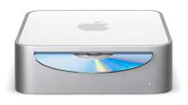 The Mac Mini is our clear favorite. It looks absolutely terrific in person. The Mac Mini is 6.5x6.5x2 inches with rounded vertical corners and weighs less than 3 pounds. It has a white plastic top and backside with ports and a brushed aluminum edge, the latter broken is only in the front by the narrow slit for inserting a CD or DVD disk and a tiny LED at lower right--very, very nice. The Mac Mini has a small white power brick that is similar to but smaller than those that come with Apple's latest aluminum monitors.
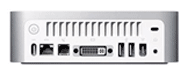 The ports in the back are all industry standard. Across the botom at right are the power, 10/100 ethernet, 56K modem, DVI graphics, two USB 2.0, FireWire 400 and sound out (headphone) ports. A DVI to VGA adapter for older or cheaper monitors is included. Across the top are the power button, heat exhaust grill and Kensington lock slot. No mouse, keyboard or monitor is included.
The base internals are a 1.25GHz G4 CPU with 512K on-chip L2 cache and a 167MHz bus, 40GB Ultra ATA hard drive, 256MB PC2700 DDR SRAM, ATI Radeon 9200 graphics, combo optical drive, Bluetooth slot, AirPort Express slot and a speaker.
The included software is: Mac OS X 10.3, Mail, iChat AV, Safari, Sherlock, Address Book, QuickTime, iSync, iCal, iLife ‘05 (includes iTunes, iPhoto, iMovie, iDVD and GarageBand), AppleWorks, Quicken 2005 for Mac, Nanosaur 2, Marble Blast Gold and Apple Hardware Test.
All of the above costs a really neat $499.
The optional build-to-order internals are a 1.42GHz G4 CPU ($100 includes 80GB drive also), 80GB hard drive alone ($50), up to 1GB RAM ($75 for 512MB and a whopping $425 for 1GB), SuperDrive ($100), Bluetooth module ($50) and AirPort Express card ($79). There is also AppleCare at $149, very high for a $499 item.
Like options on a new car or house, they can cause the total price to really skyrocket. The Mac Mini is not user serviceable according to its Apple web page and several Apple employees at Macworld. That doesn't mean that you can't buy cheaper parts and install them yourself, it just means that doing so will void your warranty. And, like an iPod, the Mac Mini is relatively difficult to open, requiring a special tool. An Apple Store Genius or Apple Authorized reseller or repair center may be able to install cheaper parts, especially RAM (1GB at $425 is ridiculous), without voiding the warranty. An external USB Bluetooth module can be obtained for far less than $50 but it uses one precious USB port. But if anyone needs to upgrade the base Mac Mini's features in any significant way, it probably makes a lot of sense to look closely at a $799 eMac, a $999 iBook or a $1299 iMac.
Remember that the Mac Mini is marketed for the user of a cheap PC as a replacement for the ugly, low quality, poor performing, virus/spyware clogged CPU box or as an easy to use and safer adjunct for email, iPod/iTunes music and even photos. The base $499 model is right down their alley.
We think the base Mac Mini will make a great PC replacement. With the included applications, the base Mac Mini seems to work every bit as well as our 1.5GHz 17" PowerBook G4 according to our subjective hands-on testing at Apple's Macworld Expo booth. It wasn't very warm either, certainly not like our PowerbBook gets. We could feel a slight discharge of warm air out the back grill and, with the din of the show floor, we couldn't hear a sound coming from it unless we held the grill up to our ear. It really needs to be tested in a reasonably quiet place but we think it will be pretty darn quiet.
As for a Mac user, the base Mac Mini makes a great replacement for an older Mac, especially one that has a USB keyboard and mouse. A lot of iMacs and Power Mac G3s and early Power Mac G4s fall into this category. An older Power Mac would just need a USB keyboard and mouse in addition to the base Mac Mini and those can be inexpensive or even found for free. We don't see much of a need for anyone to hold onto an old Mac any longer.
The Mac Mini also makes a great home or office digital hub or server as an addition to other Macs with just a few additional parts like a $19 DVI to TV video adapter, a $50 Bluetooth module, a $79 AirPort Express card, a $59 Apple wireless keyboard and a $59 Apple wireless mouse. One could even skimp a bit and use a cheaper USB external Bluetooth module and non-Apple wireless keyboard and mouse.
 The iPod Shuffle is designed to be marketed very similarly to the Mac Mini, i.e. right at the heart of the flash digital music market, not at its upper crust like the iPod Mini as Steve Jobs explained in this year's keynote and when they were announced last year. Although we haven't quite seen it that way, the market data shown before and after the iPod Mini release appear to support Steve Jobs' contention.
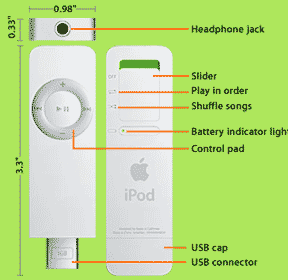
While maybe a "commodity" product starting at $99, the iPod Shuffle exhibits the genius in Apple's engineers and designers. We looked them over at Apple's booth. They are a little larger (3.3x0.98") than a regular pack of gum but much thinner (0.33") and lighter (0.78oz). There is no screen since it's business is to play a song playlist, either in straight through or in shuffle mode. Well, it can also serve as a USB thumb drive if not filled with songs.
The small wheel-like control mechanism on the front is similar to the original iPod's except, of course, there is no scroll wheel. The center button is for play and pause with the visual aid of an LED, the left and right are for backup and advance and the top and bottom are for increase and decrease volume. There's a slider on the back that is the on-off control plus it selects straight play or shuffle modes. The back also has a battery test button and LED that shows green with a full charge and turns to yellow and red as the battery runs down.
The iPod shuffle has a claimed 12-hour battery and is charged by plugging it into a computer's USB 2.0 port after removing its cap connected to a lanyard.
There are two models, the 512MB model that will hold about 120 songs for $99 and the 1GB model that will hold about 240 songs. The flash memory card is not removeable in either model.
There are also $29 Apple accessories: a sport case, an AC adapter, a dock, an armband and a battery extender. Only the latter was not available for inspection at Apple's booth. Then there's AppleCare for $59, very high for a $99 item.
The sound they produce seemed to be of equal quality to the iPod Mini and iPod, at least through the same ear buds and with the din of the show floor. One needs to try one in a quiet place to really see if the quality is the same.
We stopped by the San Francisco Apple Store on the way back to our hotel to get one and compare it with our iPod Mini since the iPod Shufffle is shipping and Steve Jobs noted that he "heard" they we available "up the street" during his keynote address. The staff said they had a good supply of only the $99 512MB model but a huge line formed right after the keynote address and they were sold out by the afternoon. Hundreds, maybe thousands, were sold but no one at the store would confirm even a ballpark a number. We'll try again today to see if they have a new supply.
The iPod Shuffle may replace our iPod Mini. Even though we have nearly 300 songs, our main playlist is only 85 songs, enough for a cross country flight. The iPod Shuffle is so small and light, we really can take it virtually everywhere.
Starting at $99, we think Apple will easily significantly increase its already fantastic growth rate of iPod sales.
We briefly used the software in iWork '05 (Keynote 2.0 and Pages 1.0) on a 14" iBook G4 and iLife '05 (iTunes 4.7.1, iPhoto 5.0, iMovie HD 5.0, iDVD 5.0 and GarageBand 2.0) on a 14" iBook G4 and a base Mac Mini. The only really new software is iWork's Pages 1.0. Most of the rest have significant upgrades. iTunes was the current v4.7.1, updated yesterday for the iPod Shuffle features.
Pages appears to be a killer word processor in the way that Keynote is a killer presentation application but more so. Actually, Pages is a combination of a simple but feature rich counterpart to Microsoft Word and a simple but feature rich counterpart to layout applications like Quark Express or PageMaker or InDesign.
There are over 40 templates ranging in complexity from a simple thank you card, to a letter (personal or business) to a quiz to a term paper to a multi-page brochure to a white paper report to a complete research paper, all with images, charts, column layouts etc. While it lacks the complex flexibility of Word, Quark, PageMaker or InDesign, Pages has all the salient features to produce the full range of professional paper documents. It imports AppleWorks documents and imports and exports Word documents.
We used Pages for quite some time despite people urging us to hurry up. The templates are masterfully done and easy to use. They are no blank spaces with arcane commands to master to fill in. They are basically a done (but dummy) product that is edited by the user in a simple and intuitive way.
IWork with Pages and Keynote 2.0 is a terrific start at a new and incredible productivity suite. As of yet, there is no spreadsheet application. FileMaker Pro is a database application that could easily be adapted to the productivity suite as a Filemaker Express. iWork is officially called iWork '05 so we expect that it will get updated and augmented regularly as has the iLife suite of applications.
Check here for details on the significant iLife '05 application upgrades.
There were no further speed bumps of the professional computer lines and, yes, there was no PowerBook G5 that we all crave. Those will come in due time as advances in manufacturing technology permits over the succeeding months. But when taken altogether, Macworld 2005 is a huge step forward for Apple with terrific new products and application upgrades in the consumer arena. It is one of the best Macworlds for new and improved Apple products that we have attended over the years. [Bill Fox]
Saw something? Send a tip or a correction
The archive ran on reader tips. What did you see, where, and do you want the credit? Something wrong on this page? Say so and it gets fixed.