Apple User Group Road Tour WAP 5/23/98
Report: Apple User Group Road Tour
Washington Apple Pi 5/23/98
Apple began (actually according to the latest schedule there were two other showings on May 20th) its Summer User Group Road Tour at today's monthly meeting of Washington Apple Pi, the Greater Washington DC AUG and the world's oldest personal computer user group in the country. The Road Tour will take some 6 weeks.
Brighid Brady-de Lambert, Apple User Group Program Manager,was joined by Mike Shebanek of Apple's iMac Team (and former Riverside, CA, AUG President) and J.D. Mankovsky a system engineer at Apple's Regional Marketing Center in Reston, VA.
For about 45 minutes prior to the start of the event, the iMac, PowerBook
G3 Series and the new flat panel monitor were displayed outside the auditorium.
The crowd of 500 or so people made it difficult to get close but I managed
to take a few pictures and touch the new products for a moment. 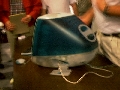 The
real crowd attractor was the iMac -- it was very difficult to get near unless
one had shown up very early. The iMac photo is from the right rear quarter
showing the new location of the ports, the power cable and the integrated
handle in white on the top. With the ports on the side rather than the back,
it's a lot easier to plug in things or remove them.The iMac's main color
is called bondi blue. It is a very vivid blue that reminds me of the ocean
in regions where the water is gin clear and the bottom is white sand, an
effect that is created by its translucent character. The other color is
officially called "ice" which is also very descriptive--it looks
like translucent ice.
The
real crowd attractor was the iMac -- it was very difficult to get near unless
one had shown up very early. The iMac photo is from the right rear quarter
showing the new location of the ports, the power cable and the integrated
handle in white on the top. With the ports on the side rather than the back,
it's a lot easier to plug in things or remove them.The iMac's main color
is called bondi blue. It is a very vivid blue that reminds me of the ocean
in regions where the water is gin clear and the bottom is white sand, an
effect that is created by its translucent character. The other color is
officially called "ice" which is also very descriptive--it looks
like translucent ice. 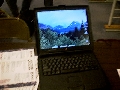
There were two PowerBook G3's and both were 250 MHz models. One had a
12.1" dual scan screen and the other a 13.1" active matrix screen.
The dual scan screen was quite bright so entry level purchasers won't be
relegated a crummy screen. However, the 13.1" active matrix screen
shown at left was so bright that it caused the picture to be way under exposed.
The 250 MHz models seemed faster than my office 8500/225 (a PowerLogix PowerBoost
Pro 225 MHz 604e accelerated to 250 MHz) and nearly as fast as my personal
9600 with a PowerLogix PowerForce G3 250 accelerated to 289 MHz. These new
PowerBooks can definitely take the place of any desktop for the road warrior.
They have a larger footprint but look a bit slimmer that my 3400 and do
not feel any heavier. The design is very seductive, with pillow-like curves,
a black grainy-rubber finish and a large white Apple logo on top and bottom.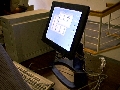
The new Apple Studio (flat panel) Display it shown at the right. Again, the brightness of the display caused my Apple QuickTake 200 digital camera to under expose the picture. It appears to be larger than my 15" monitor (it's advertised as 15.1" viewable) and nearly as large as my 17" monitor. I can't wait for this technology to enter my price range. Just look how little space is taken up by it and it is feather-light by comparison with a CRT monitor.
The turn out was the largest in recent memory of the Apple Pi members.
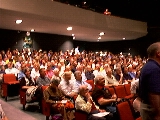 I didn't do an exact count but it looked like the auditorium held over
500 people counting the balcony. The auditorium was nearly full as can be
seen in the photo at the left.
I didn't do an exact count but it looked like the auditorium held over
500 people counting the balcony. The auditorium was nearly full as can be
seen in the photo at the left.
Brighid Brady-de Lambert introduced the people from Apple and described the Road Tour. J.D. Mankovsky gave the overview of Apple's software and hardware strategy and a few things that I hadn't heard before came out. First, J.D. said that Microsoft Internet Explorer v4.01 is ColorSync compliant. What this means is that once you set up ColorSync for your monitor, the colors you see from ColorSync-compliant web sites will be displayed identically among web sites. The example he gave was that you could visit LL Bean's on line catalog and be confident that the color you see will be the color you will get when the product arrives. He said that color dissatisfaction was one of the main reasons for returns of on line purchases.
Second, J.D. stated that when Mac OS 8.5 comes out this "summer"
(he emphasized that summer officially goes until September 21st), it will
be a major upgrade, not free and fully PowerPC native, meaning very fast.
Mac OS 8.1 is the end of the line for the 68040-based Macs. "Sonata"
or Mac OS 9? will be a major upgrade for the installed base--this means
it's for currently shipping PowerMacs and all previous PowerMacs. This led
to the obvious question about which Macs will run Mac OS X (or 10). You
will remember that Rhapsody was to run on all Macs shipping in early 1997.
However, J.D. gave the same answer that we've heard before that the currently
shipping G3 PowerMacs and those in the future will run Mac OS X and hedged
on the 603e/604e/G3-card issue. He said that Apple was not promising that
Mac OS X will run on these CPUs but that it is taking a position of promising
less and hopefully delivering more, meaning the older PCI PowerMacs might
run it. When asked specifically about the G3 CPU cards, he said they don't
know yet and mentioned that a ROM query would not tell Mac OS X that the
machine had a G3 card but a 601 or 603 or 604 CPU that originally came with
the computer. He definitely ruled out the NuBus PowerMacs even with a G3
card. This vagueness is, of course, encouraging us to get a new PowerMac
G3. However, look. By the fall of 1999 when Mac OS X comes out, the system
bus will be pushing 100 MHz, the G3-copper CPUs will be over 400 MHz, maybe
an even faster G4 generation CPU will be out, USB serial ports will be the
standard with hot swapable peripherals and FireWire will be prevalent. In
fact, J.D. spent a lot of time talking about the speed of FireWire technology
along with USB technology. I'm not going to worry about this issue any longer.
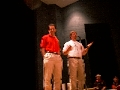
Finally, J.D. (in red at right) demoed QuickTime 3.0 with the terrific 3D game Nanosaur and showed a preview of Pixar Studio/Disney's new animated movie entitled "A Bug's Life." Marvelous!
Mike Shebanek (in white at right) demoed the iMac and discussed
its features. Mike's principal role on the iMac Team is to ensure that there
will be peripherals that use the iMac's four (not two--he says everyone
forgets that there are two on the keyboard and it is a USB hub) Universal
Serial Bus (USB) ports. On USB, he assured the audience that there
would be every kind of USB peripheral available when the iMac ships in August.
Visit the USB web site to see for yourself.
This includes floppy drives, scanners, modems, printers, etc. He extolled
the virtues of USB being cross-platform, hot swapable, faster than serial
and ADB and SCSI-2 ports and supporting up to 127 connected devices. In
the Q&A period, it was stated that there will probably not be a USB
to SCSI interface but there might be an ethernet to SCSI interface developed
by a third party. The infra-red technology was also mentioned as a means
for communicating with peripherals, the surface of that technology has not
been even scratched yet. A few members of the audience gave Mike and J.D.
a bit of a hard time over the iMac not having a floppy drive and
described how, in their view, that and the lack of a 56K modem were marketing
strategy goofs. The Apple guys held their ground. The arguments are that
floppies are yesterday's technology and are dying out and the 33.6K modem
is what most of the ISPs support today and will in the near future, i.e.
56K modems are a waste of money at the dead end as its better to have the
100Mbps Ethernet for the future--cable and ADSL (asynchronous digital subscriber
line). I think they convinced me. They will have a good time showing the
iMac and comparing it with the cheap Wintels when the iMac ships in August--watch
for this in your local CompUSA, they said. In response to a question
raised by a reporter, it was stated that they are aware that CompUSA needs
to improve the training of the Apple Store staff and that Apple and CompUSA
are working diligently on it. On the new mouse, Mike squelched the
rumor that it lights up when moved. Yeech! I had published that. I'm certain
that Steve Jobs or someone on stage mentioned that during the Apple Event
on May 6th that I attended--maybe it was an aside "joke" that
I missed as such while taking notes. Mike did say that it would be a neat
thing for a third party to do. Finally, Mike mentioned that the mouse will
have a heavy ball like the original mouse so that it will be much more precise
and require less distance movement--this is great news to me as I dislike
the light-balled mice, especially on the harder-surfaced mouse pads of today.
Lastly, the officers of Washington Apple Pi are to be thanked sincerely
for hosting this event for the Greater DC area and providing such an excellent
and interesting Saturday morning. Apple made 150 t-shirts available and
other prizes were provided for the drawing that concluded the meeting. The
Apple presentation including Q&A was nearly 2 1/2 hours and in total
I spent the better part of four hours looking at the products, listening
in the meeting and talking with people. Lawrence Charters (I originally gave Lorin Evans the credit--sorry Lawrence and Lorin) and Tom Witte,
a Director, answered troubleshooting questions for about 45 minutes at the
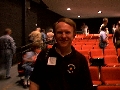
beginning. For readers who see notes from David Ottalini, a Director, posted
on Macs Only! about Washington Apple Pi events and their great Pi
Fillings CD ROM loaded with software, that's him in the photo at left. This
event will be featured on Digital Edge which airs Sunday morning at 10am
on Channel 4 in the Greater DC area.
Copyright © 1998 by Bill
Fox.
All rights reserved--no commercial use permitted without attribution.
Of course . . .
. . . and I am proud to be an Evangelista! . . .
Saw something? Send a tip or a correction
The archive ran on reader tips. What did you see, where, and do you want the credit? Something wrong on this page? Say so and it gets fixed.