Apple Files Lawsuit to Stop Misappropriation of Apple Trade Secrets
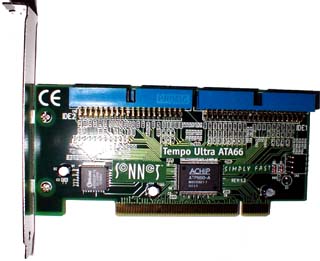
Sonnet's Tempo is one such card and the first and only one that I ran into at the Expo. At first the Sonnet representative seemed a bit hesitant about admitting that the Tempo was in fact manufactured by Acard for Sonnet. Then he seemed relieved to learn that I was actually looking for a rebranded Acard and he added that Acard had tweaked the firmware to Sonnet's specifications, setting it apart from the Acard or other rebranded controllers. Looking closely at the card (above), one can see that Sonnet's name and slogan are affixed with tape rather than silk screening. In addition, ATTO's ExpressPro Tools says that the Sonnet Tempo is an Acard (below, left window).
 Hands-On Review--Sonnet Tempo ATA66 Controller: Frequent readers will remember that one of my quests at Macworld Expo was to obtain a rebranded Acard ATA 66 controller. Why? Partly because I am tired of the vagaries of SCSI which is no longer really supported by Apple but mostly I am tired of trying to find SCSI drives with 50-pin connectors of reasonable size, speed and cost. The Acard controller (adapter) is inexpensive, well reviewed and allows the use of very fast, large and inexpensive ATA66 hard drives that are found even in office supply stores.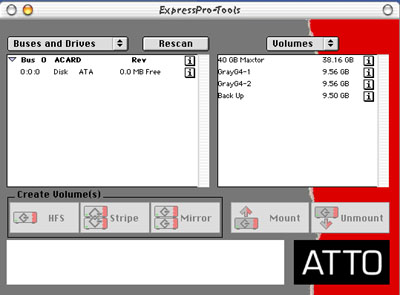
The Tempo was "on sale" at Macworld Expo for $93+ and with tax came out to be exactly $100, a very reasonable price for a very fast controller, especially a very fast SCSI controller. The Sonnet Tempo is also less expensive than other Mac ATA66 controllers. It will retail for $99.95 plus tax and shipping so the show special wasn't all that special. The Tempo came well-packaged in box printed in three languages: English, French and Spanish. The card came in a static-free pouch and was held down from rattling about by stretched plastic film. A single ATA cable and an extensive manual came with the Tempo. The 43-page manual covers configuring the hard drive, hard drive initialization, very detailed installation instructions for three classes of Macs (desktops, towers and B&W G3/G4s), troubleshooting, warranty and customer service. Sonnet provides a three-year warranty.
The Tempo is a two-channel card so it can control four drives in total, a master and slave on each of two cables (only one cable is supplied with the card). I tried out the Sonnet Tempo in a Power Mac 7300 and a Power Mac G4 connected to an inexpensive but very fast and large Maxtor Diamond Plus 7200 RPM 40 GB ATA66 hard drive. The 40 GB drive sells for right around $200 these days. Installation is simple. The Tempo just presses into a vacant PCI slot on the computer's motherboard. It has two connectors and either may be chosen if using only one or two drives. The master drive must always be placed at the end of the cable whether a slave drive is used or not. There is one unsettling and very inconvenient feature of the Tempo. When a drive is hooked up it must be initialized whether it is new (clean) or it has been initialized before and has data on it. This means that drives can't be swapped around without the loss of data. I had to reinitialize the 40 GB drive when I moved it and the Tempo from the 7300 to the Power Mac G4. I am not sure if this is just a Tempo issue or a general ATA66 controller issue but I certainly do not like it.
I ran a number of benchmarks to compare the Tempo/40 GB Maxtor with the motherboard controllers/internal drives in the 7300 and G4. Here are the MacBench 5.0 Disk scores and sustained read and write measurements by ATTO's Express Tools:
| Computer (Controller/Drive)* | Mac Bench 5 Disk | Sustained** Read | Sustained** Write |
|---|---|---|---|
| Score | (MB/sec) | (MB/sec) | |
| Power Mac 7300*** | |||
| - Internal/IBM 4.5 GB SCSI |
|
|
|
| - Tempo/Maxtor 40 GB ATA66 |
|
|
|
| Power Mac G4/400 Sawtooth | |||
| - Internal/WDC 20 GB ATA66 |
|
|
|
| - Tempo/Maxtor 40 GB ATA66 |
|
|
|
* Mac OS 9.0.4, VM off; **ATTO ExpressTools, File Size 8 MB, sample 4; ***400 MHz G3 Upgrade
The results in the 7300 are consistent. The Tempo/Maxtor combination in the 7300 was much faster than the internal SCSI/IBM SCSI combination in both the MacBench 5.0 score and ATTO measurements.
The results in the G4 are also consistent. The stock internal ATA66/Western Digital drive combination was slower on the MacBench benchmark and similarly slower than the Tempo/Maxtor combination in the ATTO measurements.
In summary, the Tempo controller with the Maxtor drive is a very fast combination for around $300 together and is a bargain for 40 GB of storage. I was able to boot both the 7300 and G4 from the Maxtor drive controlled by Sonnet's Tempo. Unfortunately, the Tempo has another drawback--the G4 would not sleep with the Tempo installed. Potential buyers should be aware of the Sonnet Tempo's limitations: the inability to use sleep on the G4 and the inability to swap a drive in and out without initialization. Here is another review on Low End Mac.
Saw something? Send a tip or a correction
The archive ran on reader tips. What did you see, where, and do you want the credit? Something wrong on this page? Say so and it gets fixed.