Hands-On Report--Quiet Your ATI Radeon 9800 Pro Part II, the Zalman Heatpipe
We decided to get rid of the whine and found two promising methods. Last week we reported on our successful replacement of the 9800 Pro's stock fan/heatsink with a very quiet Verax G01 fan/heatsink. While it wasn't easy to do and is not supported by Verax for the 9800 Pro card, the Verax G01 fan worked and continued to work with no apparent problems until we removed it for today's solution. Later last week, Accelerate Your Mac! posted a note that there is a Verax G03 fan that is supported for the 9800 Pro but it was still not listed on the Verax web site at publication time.
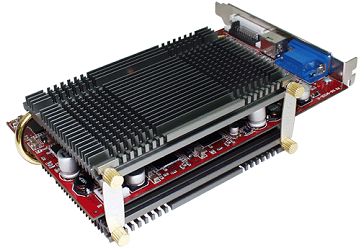 The second method for quieting our 9800 Pro is to use the Zalman Noiseless VGA Heatpipe Cooler ZM80C-HP ("Zalman Heatpipe"), shown at right, instead of a fan. The only apparent problem is that there is not enough room under the 9800 Pro in the Power Mac G5 for the heatsinks connected by the heatpipe to straddle the 9800 Pro. However, we thought that it might be possible to stack the heatsinks on the top side of the card. We see no reason why stacking them on one side would provide less cooling than with them straddling the card so we ordered a Zalman Heatpipe from Endpcnoise.com for $35 to see.
The Endpcnoise web site recommends that the Zalman fan ZM-0P1 be used with the 9800 Pro but does not say that it is required as is does with other video cards. The ZM-0P1 is a very large 80x80x15 mm, low-RPM and quiet fan. We decided to not follow the recommendation because the Power Mac G5's PCIX card compartment already has a fan and there is not enough space anyway.
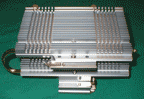
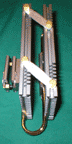
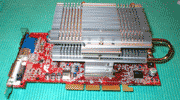
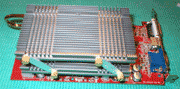
Removing the original fan/heatsink is easy as we noted last week. The Zalman Heatpipe is also very easy to assemble. The photos below show the Zalman Heatpipe assembled as a stack by itself. Note the supports between the two heatsinks in the right photo which minimize concern for bending the gold heatpipe (double click for a larger image):
 |
 |
|
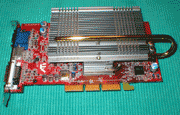
The following photos show the Zalman Heatpipe assembled as a stack attached to the 9800 Pro. The first photo (upper left) shows the first heatsink attached with the gold heatpipe over the heatsink rather than around under the card. The second (upper right) shows the second heatsink attached on top. The third photo shows the supports.
 |
 |
|
 |
||
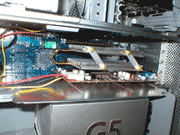
The final photo shows the assembly installed in the Power Mac G5.
 |
|
Unfortunately, stacking the heatsinks on top of the 9800 Pro covers two PCIX slots, reducing the usable number of slots to just one. While it appears in the photo that the third slot may also be covered, the heatsinks can be adjusted to be a bit lower. In our case, it doesn't matter since we don't use any of the PCIX slots, at least not yet.
We have used this rig for several hours each playing the demanding 3D games Medal of Honor Allied Assault--Spearhead and Return to Castle Wolfenstein and have not noticed any heat-related problems. Both heatsinks get hot to the touch but seemingly no hotter than the heatsinks on other graphics cards we have touched. In addition, the heat-modulated Power Mac G5's fan in the PCIX compartment has never spun faster than its nominal low rate.
So far so good. While we have experienced no immediate acute problems, we do not know if the 9800 Pro is being overly stressed such that there may be some long-term problems. We don't think so since this model of Zalman Heatpipe (ZM80C-HP) is recommended for the 9800 Pro but only time will tell. Best of all, for a mere $35 our dual 2-GHz Power Mac G5 with the superb ATI Radeon 9800 Pro is once again as quiet as it is with the stock 9600 Pro which has no fan and that is very quiet indeed.
Saw something? Send a tip or a correction
The archive ran on reader tips. What did you see, where, and do you want the credit? Something wrong on this page? Say so and it gets fixed.