Hands-On Review--Apple's New Fabulous 24" iMac Core 2 Duo, How Fast Is It?
We ordered our 24" iMac from the Apple Store with the fastest CPU (2.33GHz) for $250 extra and fastest graphics card (Nvidia GeForce 7600 GT) for $150 but otherwise stock. The CPU upgrade is probably an extravagance because it is only 8 percent faster than the stock 2.16GHz CPU. But we wanted to see if the 24" iMac would be a good enough game machine to keep us from ultimately replacing our now-sold Power Mac G5 Quad with a new Mac Pro. We thought about upgrading the RAM from 1GB to 2GB but since we won't use many non-Universal applications on the iMac we decided not to upgrade the RAM.
Our upgraded 24" iMac arrived a week ago directly from Shanghai just 5 business days after we ordered it. The first thing one notices is how much larger the 24" iMac is compared with the former largest 20" iMac (see image below).
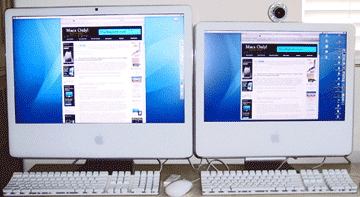
Despite its much larger size, the 24" iMac is only slightly heavier than the 20" iMac (24.7lbs vs 22lbs). The other major external differences are the built-in iSight, the ports in the back are arranged horizontally on the lower right instead of vertically, one FireWire 400 port is now a FireWire 800 port and the power button is on the lower left back rather than the right.
Internally, there is a 2.33GHz Intel Core 2 Duo CPU vs a 2GHz G5, 1GB RAM vs 512MB, an Nvidia GeForce 7600 GT graphics card with 256MB video RAM vs an ATI Radeon 9600 with 128MB video RAM, an 8x double-layer SuperDrive vs a single-layer SuperDrive and a 250GB SATA hard drive vs a 250GB parallel ATA hard drive. The 24" iMac has a new 24-watt digital amplifier for better audio-out than any other iMac past or present.
While there are many gains, there are also a couple of small hardware loses--one less FireWire 400 port (displaced by a FireWire 800 port) and no modem. More importantly to some, the software suite loses AppleWorks and Quicken so there is no "business" software at all except trial versions of iWork '06 and Microsoft Office 2004.
Out of the box, we were up and running quickly. It took a little over 30 minutes to transfer the user folder from our 20" iMac G5 to our 24" iMac Core 2 Duo using a FireWire cable and Mac OS X's excellent Migration Assistant application. We had no problems connecting up with our AirPort Extreme network after adding the 24" iMac's AirPort ID to each AirPort Base Station.
Right off the 24" iMac seemed clearly faster than any other Mac we've ever used, including our ex-PowerMac G5 Quad and our 2.16 GHz 15" MacBook Pro. Could that be so? We ran our suite of speed tests on the 24" iMac. The tests consist of four benchmarking applications, five "real world" operation tests and five 3D video games. For comparison, we also ran the speed tests on the retiring 2GHz 20" iMac G5 and our 2.16GHz 15" MacBook Pro. The results for our ex-Power Mac 2.5GHz G5 Quad are included for informational purposes but they are not strictly comparable because it ran Mac OS X 10.4.6 and since April Xbench was updated and changed from v1.2 to v1.3. And, of course, the Mac Pro's with two dual core CPUs up to 3GHz and an optional ATI Radeon X1900 graphics card replaced the Power Mac G5's in August.
Here are the results:
| Test | Mac | |||
|---|---|---|---|---|
|
24" iMac Core 2 Duo
|
20" iMac G5
|
15" MacBook Pro
|
Power Mac G5 Quad
|
|
| Benchmarks: |
2.33 GHz
|
2.0GHz
|
2.16GHz
|
2.5GHz
|
| Altivec Fractal+ (GFLOPS) |
8.7
|
5.1
|
4.1
|
25.3
|
|
Cinebench 2003 (9.5.1)-Rendering (2X)
|
724
|
272
|
628
|
1194
|
|
- OpenGL Hardware Lighting
|
4418
|
1182
|
2888
|
2219
|
| Let1kWindowsBloom 1.0 (sec) |
7
|
9
|
15
|
6
|
| Xbench 1.3 - CPU |
120
|
93
|
83
|
124
|
| - Threading |
234
|
60
|
210
|
243
|
| - Memory |
130
|
64
|
118
|
132
|
| - Quartz Graphics |
166
|
106
|
113
|
149
|
| - OpenGL Graphics |
144
|
123
|
157
|
136
|
| - User Interface Graphics |
472
|
66
|
246
|
236
|
| "Real World" Tests: | ||||
| Startup (sec) |
18
|
40
|
28
|
41
|
| Shutdown (sec) |
7
|
8
|
10
|
12
|
| Dup. 500 MB Folder of Files (sec) |
25
|
65
|
33
|
34
|
| Scroll Adobe 7.0.8+ Reader File (sec) |
42
|
47
|
68
|
32
|
| Export QT FQDV in iMovie HD (sec) |
38
|
-
|
47
|
44
|
| Games | ||||
| Quake 3 Arena Intel/PPC+(frames/sec) |
835/200
|
-/141
|
426/135
|
-/417
|
|
Halo 2.0/1.5.2+ (frames/sec)
|
91/-
|
-/20
|
40/25
|
-/31
|
| Call of Duty 1.5+ (frames/sec) |
58
|
57
|
35
|
84
|
| Doom 3 1.3A (frames/sec) |
128
|
32
|
62
|
53
|
| Quake 4 (frames/sec) |
95
|
29
|
66
|
-
|
The rash of red in the first column says it all--the 24" iMac with a 2.33GHz Core 2 Duo CPU and Nvidia GeForce 7600 GT graphics is one fast machine. It beats the pants off the 2GHz iMac G5 and handily crushes the 15" 2.16GHz MacBook Pro also with one exception--the latter difference in Xbench OpenGL Graphics is less than 10 percent so probably is not significant. On other graphics tests involving OpenGL the 24" iMac is much faster than the 15" MacBook Pro--Cinebench 2003 and the 3D games. The 24" iMac really blows away the others on the Xbench User Interface test, confirming its very fast impression using the Finder.
The 24" iMac is the startup king. We've never measured a faster startup time from chime to complete desktop than 18 seconds. It's also the fastest among the iMac G5 and MacBook Pro in shutting down, duplicating a 500MB folder with and scrolling in Adobe Reader. It beats the MacBook Pro in exporting a full quality digital video movie in iMovie HD. The iMac G5 has iLife '05 installed and iMovie HD 5.0.x is not comparable with v6.0.2--the latter is much slower for some reason.
As expected, the 24" iMac really shines with 3D games. It even gets a very playable 58 fps in Call of Duty running in Rosetta emulation whereas the MacBook Pro's score of 35 fps is marginal and an incredible 835 fps in the Universal version of Quake III Arena. The speed of newer games with Universal binaries--Halo, Doom3 and Quake 4--is excellent with fps of 91, 128 and 95 respectively at our test settings.
The 24" iMac generally holds its own or bests scores of the Power Mac G5 Quad in the benchmark tests, the notable scores highly favorable to the iMac are Cinebench's OpenGL Hardware Lighting and Xbench's User Interface tests. The 24" iMac beat the G5 Quad in four of five tests in the real world category and three of four 3D game tests.
Since the 3D game scores are so good at our settings, i.e. the ones we normally play at, it is possible to increase the resolution or increase the video quality settings and still get an acceptable frame rate of around 60 fps. For example, here are the results of doing so with Doom3:
1. Standard Video with Better Resolution Settings: 120 fps
- High Video Quality
- Resolution: 1024x768
- Shadows: Off
- Antialiasing: Off
2. Best Video Settings: 98 fps
- Ultra Video Quality
- Resolution: 1024x768
- Shadows: On
- Antialiasing: Off
3. Best Video and Resolution Settings: 57 fps
- Ultra Video Quality
- Resolution: 1600x1200
- Shadows: On
- Antialiasing: Off
4. Best Video and Resolution plus Antialiasing: 19 fps
- Ultra Video Quality
- Resolution: 1600x1200
- Shadows: On
- Antialiasing: 2x
Enabling antialiasing is the real speed killer. We prefer the higher frame rate at a resolution of 1024x768 even on a 24" Cinema Display. To our eyes, 1024x768 is enough resolution to make out an enemy across a map and 1600x1200 makes them too much smaller even if better defined--YMMV.
Apple has finally produced an excellent game machine in its consumer line with the upgraded 24" iMac. While our MacBook Pro is perfectly good for the games we tested, the upgraded 24" iMac really shines. And we ran into no problems while using it this past week.
The 24" iMac Core 2 Duo very nicely fills the gap between a true consumer Mac and the Mac Pro. Apple calls this marketing space "prosumer." It has high end capabilities and even a fast FireWire 800 port. The 24" iMac is upgradable to a degree as a configure-to-order purchase from the Apple Store--CPU, RAM, graphics and hard drive can be upgraded. Hopefully, these parts will also be upgraded by third party manufacturers and easily installed.
With the top-end 2.33GHz CPU and Nvidia GeForce 7600GT graphics as upgrades, the 24" iMac retails for $2,374. It has a faster CPU (although just one), faster graphics and a larger screen than the low-end 2GHz Mac Pro which retails for $3,198 with a 23" Cinema Display. The upgraded 24" iMac is quite a bargain at $824 less than the Mac Pro if one does not need the expandability of a Mac Pro. [Bill Fox]
Saw something? Send a tip or a correction
The archive ran on reader tips. What did you see, where, and do you want the credit? Something wrong on this page? Say so and it gets fixed.