EVGA GeForce GTX 285 in an Early 2008 Mac Pro--How fast is it?
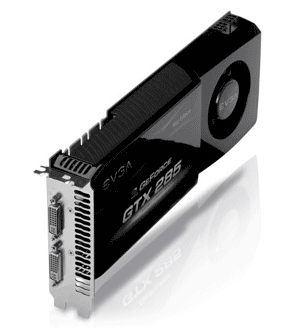
Frequent readers know that I am a seriously addicted gamer on the Mac. Last month my ATI Radeon HD 4870 arrived after ordering it in March. It was the card I had been looking for on the Mac for nearly a year. It didn't disappoint as noted in last month's speed test.
About that time rumors began circulating that EVGA would make the Nvidia GeForce GTX 285 available for the Mac (e.g. see this one). While the 285 is not the latest Nvidia graphics card, it is much more recent than ATI's 4870 and in tests the 285 kicks the Radeon's butt, running nearly as fast as a Radeon 4870X2 with two GPUs. Sure enough, the rumors were true and EVGA's GeForce GTX 285 for the Mac is now available on the Apple Store for $449.95, $100 more than the ATI 4870. I ordered one immediately and it arrived this past Thursday while I was out of town, of course.
Like the 4870, the GTX 285 is two PCIe slots wide and uses both electrical connections from the Mac Pro's motherboard. However, the first 16-lane PCIe 2.0 slot is offset so that the GTX 285 does not cover any of the remaining PCIe slots. The GTX 285 does not have the full slot extension piece that the 4870 has making it a little more difficult to correctly position the EVGA card. EVGA included a CD with drivers but I found a more recent set of drivers on EVGA's web site.
EVGA's GeForce GTX 285 for the Mac has two dual-link DVI ports so it can drive two 30" Apple Cinema Displays. In comparison, the ATI 4870 has only one dual-link DVI port but it also has a new mini DisplayPort and there is a $99 adapter to make it into a dual-link DVI port. So, the ATI 4870 is a bit more versatile if you have the extra cash. The GTX 285 has 1GB of onboard DDR3 memory versus 512MB of GDDR5 memory in the ATI 4870. Both cards require Mac OS X 10.5.7.
So how fast is the EVGA GeForce GTX 285?
To find out, I ran a graphics-related subset of my usual speed tests on my dual quad-core 2.8GHz Mac Pro with 6GB of RAM running Mac OS X 10.5.7 using both graphics cards plus the original graphics upgrade that came with the Mac Pro, an Nvidia GeForce 8800GT. Here are the results:
| Test | EVGA GeForce GTX 285 | ATI Radeon HD 4870 | Nvidia GeForce 8800 GT |
|---|---|---|---|
BENCHMARKS/Mac OS X Version |
10.5.7 | 10.5.7 | 10.5.7 |
Cinebench R10 Rendering (8x) |
18768 | 18740 | 18751 |
-OpenGL Hardware Lighting |
5961 | 6328 | 5927 |
Xbench 1.3 |
|||
- Quartz Graphics |
239 | 241 | 244 |
- OpenGL Graphics |
177 | 215 | 174 |
-User Interface Graphics |
406 | 406 | 450 |
GAME TESTS |
|||
Quake III Arena (frames/sec) |
979 | 998 | 981 |
Halo 2.0.3 (frames/sec) |
173 | 211 | 169 |
What? The ATI 4870 is faster and the GTX 285 is no faster than the 8800GT! Yes, that's true for these tests but gaming is all about fast, furious and copious pixels. The lower resolutions (1024x768) and graphics limitations (no FSAA for example) of my usual speed tests don't tax these new graphics cards' abilities. Hey, this is the new era in Mac gaming. You don't have to dumb down the settings any longer!
So I upped the resolution to that of 20" monitor, 1600x1200. Here are the results:
| Test | EVGA GeForce GTX 285 | ATI Radeon HD 4870 |
|---|---|---|
BENCHMARKS/Mac OS X Version |
10.5.7 | 10.5.7 |
GAME TESTS |
||
Quake III Arena (frames/sec) |
974 | 995 |
Halo 2.0.3 (frames/sec) |
166 | 204 |
The ATI 4870 still beat the EVGA GeForce GTX 285. This probably because the eye candy is still dumbed down and serious gamers may use an even higher resolution. These graphics cards are for serious gamers.
I re-ran the gaming tests with the GTX 285 and ATI 4870 with maximum resolution (2048x1536 for Quake III Arena and 2560x1600 for Halo) plus maximum eye candy (Trilinear filter for Quake III Arena and 4x FSAA, Lens flare High, Model detail High and Smoke particles High for Halo). Here are the results:
| Test | EVGA GeForce GTX 285 | ATI Radeon HD 4870 |
|---|---|---|
BENCHMARKS/Mac OS X Version |
10.5.7 | 10.5.7 |
GAME TESTS |
||
Quake III Arena (frames/sec) |
970 | 962 |
Halo 2.0.3 (frames/sec) |
124 | 84 |
Now this is more like it. The GTX 285 beat the ATI 4870 on both tests and very significantly for the more important Halo test. The speed of Quake III Arena depends largely on the CPU rather than the GPU and, in reality, no longer is a good test. Halo was the first game on the Mac to really tax the GPU on the graphics card in addition to the CPU. It is still a very good test and the GTX 285 bested the ATI 4870 on my Mac Pro by over 47%.
I still play Halo so it is great finally to be able to play it well at maximum resolution and maximum eye candy on my 30" Apple Cinema Display. But more frequently I play Call of Duty 4 (CoD4), my all-time favorite game to date. I do play it using Boot Camp on Windows XP since it took so long for the Mac version to come out. I'm sticking with the Boot Camp version, partly because I don't want to waste my time playing up through all the ranks again. I have been playing CoD4 with the EVGA GeForce GTX 285 on my Mac Pro and 30" Cinema Display at 2560x1600 resolution and I am even more competitive due to better vision and no slow downs than at the lower resolution of 1600x1000 that I was using with the ATI Radeon HD 4870.
In summary, if you are a serious gamer with a late model (2008 or 2009) Mac Pro and want to play at maximum resolution with all the eye candy enabled, I recommend the EVGA GeForce GTX 285 for the extra $100 over the ATI Radeon HD 4870. The ATI 4870 comes close and is even better at lower resolutions for $100 less if that matters. Another consideration is that the ATI 4870 is an official Apple card and is likely to be supported in future versions of Mac OS X. Hopefully, EVGA will also continue to support its first Mac graphics card and even give us better ones in the future. [Bill Fox]
Saw something? Send a tip or a correction
The archive ran on reader tips. What did you see, where, and do you want the credit? Something wrong on this page? Say so and it gets fixed.