Review of phase 5's Maccelerate!750 G3 375 CPU Card

Hands-On Review: Maccelerate!750 G3 375 MHz Card
phase5 Digital Products Price: $869.95 from The Software Hut
January 4, 1999
Pros: Simple to install, small number of bus settings to worry about, ran stable without a hitch, ran in a PowerComputing PowerBase!, outstanding value for 375 MHz G3 CPU
Cons: Means to optimize performance limited, heat sink clips could be stronger, certified compatible with only Apple and UMAX systems
Rating: Excellent, 4.5 out of 5 Exclamation Points: ! ! ! !!
G3 processor upgrade cards are better than sliced bread. They transmogrify a PowerMac, almost any PowerMac these days, into a veritable speed demon. The clock speed of G3 CPU cards have pushed past 300 MHz all the way to 400 MHz as of the publication date of this review. phase 5 Digital Products, a German company, markets a full line of G3 CPU upgrade cards for PCI PowerMacs (7300-9600's, except 8600/9600 Mach5's) and UMAX S900's that have their CPU's on a replaceable daughter card -- the Maccelerate!750 line. They also produce CPU cards for the 4400/6400 PowerMacs which fits into their L2 Cache slot -- the Maccelerate!750TA line. phase 5 also markets G3 ZIF CPU cards for G3 PowerMacs -- the Power Booster G3 line. The Maccelerate's range from a 250 MHz model with 512 K of backside cache to a 400 MHz model with 1 MB of backside cache. All of the Maccelerate!750's are set to run at a 2:1 ratio of CPU clock speed to backside cache clock speed. Well, now the Maccelerates and Power Boosters are coming to America! The Software Hut is retailing the phase 5 line up in the US.
The Software Hut loaned Macs Only! a Maccelerate!750 375 evaluation unit for this review.
Compatibility: The Maccelerate!750's, as noted in the manual and phase 5's web sites, are compatible with all PowerMacs from 7300 through 9600, excluding the Mach 5's (8600/250/300 and 9600/300/350), and the UMAX S900. I suspect that the corresponding PowerComputing computers are also compatible but they have not been certified as such by phase 5. I tried the Maccelerate!750 375 in a PowerBase 180 and it ran stable -- more below!
What you get
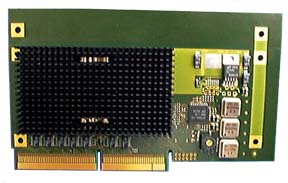 The Maccelerate!750 375 came in an antistatic bag held firmly in clear plastic film in a heavy-duty box with a colorful cover. Also included were a diskette, a manual and a registration card.
The CPU card, shown at right, is neat and well made. It is a tall card and unlike most CPU cards, the Maccelerate has components attached on both sides of the card. Heat from the G3 CPU is dissipated by a modest aluminum heat sink (black) which covers the IBM PowerPC 366 MHz CPU and the two backside cache chips. Since the Maccelerate!750 375 has a 366 MHz chip, it is overclocked by about 2.5% in stock form. The heat sink is held on by two smallish clips so care must be taken to handle the card by its top edge and to avoid pressing on or pulling on the heat sink in any way.
The Maccelerate has two means to optimize its performance. First, there is a dial switch shown above at the lower right part of the card, just to the left of the boxy silver bus clock crystal components. The dial on the Maccelerate!750 375 allows the selection of one of three system bus speeds, 46.2, 50 or 53.6 MHz, by using one of the three clock crystals on the board. Increasing the bus speed simultaneously decreases the ratio between the CPU speed and the bus speed to keep the CPU speed at about 370-375 MHz as follows:
| Dial Setting | Bus Speed (MHz) | Ratio | CPU Speed (MHz) |
|---|---|---|---|
| 0 | 46.2 | 8:1 | 369.6 |
| 1 | 50.0 | 7.5:1 | 375.0 |
| 2 | 53.6 | 7:1 | 375.2 |
The Maccelerate also has a fuse wire on the reverse side of the card that may be cut to allow the CPU to be further overclocked. Doing so is not easy and it will void your warranty according to phase 5's Maccelerate manual. Still, phase 5 provides the following data:
| Dial Setting | Bus Speed (MHz) | Ratio | CPU Speed (MHz) |
|---|---|---|---|
| 4 | n/a | n/a | n/a |
| 5 | 50.0 | 8:1 | 400 |
| 6 | 53.6 | 7.5:1 | 402 |
As noted above, the Maccelerate is a tall CPU card. However, about 7/8" below the top of the card is a clear zone where the card may be trimmed off with a saw used on printed circuit boards so that it fits into low profile desktop cases like the PowerComputing PowerBase -- more on this later.
The diskette has an installer, and instructions and tech info files. Double clicking on it places the Maccelerate control panel, BCache, in the system folder. BCache enables the backside cache which provides the G3 CPU with its vast speed advantage. It has settings for the cache size [either 512K or 1024 K (1 MB)] and the CPU to backside cache speed ratio.
The manual is a 28-page 5" by 7" black and white booklet. The first half is in German and the second half is in English. There are nine photographs illustrating how to install the Maccelerate in Apple desktop and tower computer designs. The control panel, setting the bus speed and overclocking by cutting the fuse wire are discussed. There is also a section on the bus speeds of various Macs and clones and an Addendum that discusses the boot problem with the Adaptec 2940 Ultra-wide SCSI controller common to many G3 CPU cards. The one-year "guarantee" is described. Technical support and service is via phase 5's web site and e-mail but one is directed to contact the retailer for "guarantee" issues.
The registration card is in German and English. It is mailed to phase 5 in Oberursal, Germany. phase 5 provides a one-year warranty. Again, warranty issues are handled by the local retailer rather than phase 5 in Germany, a real convenience to purchasers.
Installation and Use
The two test computers were configured the way I normally use them as follows:
- Apple Power Macintosh 9600 (non-Mach 5 version)
- Original CPU: Apple PowerPC 604e/200 MHz with 512k onboard L2 cache and system bus at 50 MHz
- Other Test CPUs:
- Vimage Vpower G3 300 MHz with 512 K backside cache at 150 MHz and system bus at 46.h MHz
- PowerLogix PowerForce G3 250 MHz with 1 MB backside cache tweaked to 300 MHz with the cache at 200 MHz and system bus at 50 MHz
- 128 MB RAM
- Graphics: ATi Xclaim VR Pro (8 MB SGRAM) & MacMagic 3Dfx (8 MB SGRAM & No Tweaker)
- Mac OS 8.5.1, Virtual Memory on at 1 MB, LibMoto extension on
- PowerComputing PowerBase 180
- Original CPU: PowerPC 603e with 516 K L2 cache in slot and system bus at 40 MHz
- 56 MB RAM
- Graphics: MacPicasso 540 with 3D Overdrive 3Dfx module
- Mac OS 8.5.1, Virtual Memory on at 44 MB in addition to physical RAM, LibMoto extension on
Installation of the software and the Maccelerate!750 375 card was easy and the same as with all CPU daughter cards that use the processor card slot (some use the L2 cache slot). With my existing CPU card still in, I inserted the diskette, double-clicked the Bcache installer, disabled the extensions/control panels for my existing CPU and shutdown. Then I opened the case of my computer and gently but firmly pulled the existing CPU out of its slot on the motherboard with little to no rocking motion since rocking can damage the slot. Then I set the Maccelerate!750 375's dial to "0" and pressed the Maccelerate!750 375 firmly and straight into the slot using both hands on the top edge of the CPU card, avoiding pressing on the black, finned heat sink. I made sure that the CPU card was seated all the way down into the slot because the computer will not boot otherwise, a common problem, then started up without closing the case to ensure everything was done correctly.
The Maccelerate!750 375 ran at the "0" setting (CPU 369.6 MHz, cache 184.8 MHz, bus 46.2 MHz) on both the 9600 and the PowerBase! The PowerBase result was a real surprise since phase 5 does not claim that they do and since so few G3 CPU cards on the market run in PowerBases and most of those that do are manufactured specifically for the PowerBase so they cost a premium. The exception is the G3 cards from PowerLogix. The Maccelerate!750 375 also ran at setting "1" and "2" on the 9600 but those settings were not stable on the PowerBase presumably because the PowerBase has a normal bus speed of 40 MHz which can't be tweaked to 50 or 53.6 MHz.
As mentioned above, a fuse wire on the back side of the Maccelerate!750 375 can be cut to allow it to be overclocked further. Remember that doing so voids the warranty but I was permitted to do so for the review. It was not easy but an exacto knife did the job. Unfortunately, the 9600 would not completely boot at either setting "5" or "6" which would have allowed CPU speeds of 400 and 402 MHz. It got to the "Happy Mac" or just beyond and froze every time on both settings. While the speed tolerance of G3 CPUs ranges fairly widely, apparently the G3 CPU in the test card maxes out between 375 and 400 MHz. I do not recommend doing this but it had no detectable negative effect on the card.
I used the Maccelerate!750 375 on setting "2" (CPU 375.2 MHz, cache 187.6 MHz, bus 53.6 Mhz) in all tests with the 9600 and during two weeks of use since it is the fastest setting available. I used setting "0" on the PowerBase tests but did not have time to extensively use the Maccelerate!750 375 with the PowerBase -- I did extensively play Tomb Raider II one day, however, with no problems.
I ran MacBench 4.0 for the speed tests instead of MacBench 5.0 because 5.0 crashes too frequently on several of my computers and won't even boot on my PowerBase 180. I also ran the famous BYTEMark (DR3) speed tests. The game Unreal was used to test the CPU and 3Dfx graphics card interaction since Unreal's frame rate is more sensitive to CPU speed than most 3D games. The Walker Atrium spin minimum frames per second tests the handling of QuickTime 3D. Finally, I recorded the time in seconds to launch GoLive's CyberStudio 3.1.1 and parse a 106 MB HTML file (Macs Only!'s CompUSA WATCH). Here are the 9600's results:
| Test |
phase 5
Maccelerate!750 @ 375.2/187.2/1 MB |
Vimage
Vpower G3 300/150/512 |
PowerLogix
G3 250 @ 300/200/1MB |
Apple
604e/200 |
| MacBench 4.0 Processor | 1310 | 921 | 1076 | 432 |
| MacBench 4.0 Floating point | 1198 | 963 | 963 | 652 |
| MacBench 4.0 Graphics | 646 | 562 | 579 | 377 |
| BYTEmark Processor | 12.4 | 10.0 | 10.0 | 6.1 |
| BYTEmark Floating point | 8.2 | 6.6 | 6.6 | 4.4 |
| Unreal Castle Flyby (avg. frames/sec) | 25 | 21 | 22 | 18 |
| Walker Atrium Spin (min. frames/sec) | 19 | 17 | 18 | 12 |
| Parse 106 MB HTML File (sec) | 30 | 39 | 35 | 64 |
The Maccelerate!750 375 tested on the order of 70-100% faster than the original 604e/200 MHz CPU in most cases. It nearly tripled the MacBench CPU score and doubled the BYTEmark. It increased the Unreal frame rate and the minimum frame rate in the Walker Atrium spin by about 50%. CyberStudio was launched and the 106 MB file was parsed twice as fast. The Maccelerate!750 375 was generally 15-25% faster than the two other G3 cards running at 300 MHz. It is a very fast card for those who need or want the speed that these second generation IBM G3 CPUs bring.
Here are the results for the Maccelerate!750 375 on setting "0" in the PowerBase:
| Test |
phase 5
Maccelerate!750 @ 369.6/184.8/1 MB |
| MacBench 4.0 Processor | 1214 |
| MacBench 4.0 Floating point | 1160 |
| MacBench 4.0 Graphics | 561 |
| BYTEmark Processor | 10.8 |
| BYTEmark Floating point | 7.8 |
| Unreal Castle Flyby (avg. frames/sec) | 24 |
| Walker Atrium Spin (min. frames/sec) | 17 |
| Parse 106 MB HTML File (sec) | n/a |
There is about an 8-15% speed hit in the PowerBase due to the decreased CPU, cache and bus speed and perhaps due to the high Virtual Memory setting to run Unreal. However, the speed hit on the Unreal test itself was less than 5%. The fact that it runs in a PowerBase and runs so well is a real plus for this CPU card.
Conclusions
phase 5's Maccelerate!750 375 is an excellent G3 CPU card for all 604-based PCI Apple PowerMacs and UMAX SuperMacs. I suspect that it will run on equivalent PowerComputing Mac clones although it has not been certified by phase 5 to do so. The Maccelerate!750 375 did run extremely fast and well on my 603e-based PowerBase so it may be even more broadly compatible. I am not absolutely certain but I think the limitation was bus speed so the 375 MHz version may be the fastest Maccelerate!750 that runs on the PowerBase. In either computer, this is one very fast G3 CPU card. This card is made for those who want to install a very fast 375 MHz G3 CPU card in their computer and have it run positively stable with minimal optimization options. Those who want to tweak and optimize their G3 CPU card performance for that last ounce of speed may want to look elsewhere but at a significantly higher cost. The Maccelerate!750 375 retails for $868.95 at The Software Hut. Checking the latest MacMall catalogue reveals that four competing 366 MHz G3 cards range from $899.99 to $1199.99 to $1299.99 and $1299.99. Clearly the Maccelerate!750 375 is the value leader among its peers.
Many thanks to The Software Hut for loaning the Maccelerate!750 375 for this review.
Copyright © 1999 by Bill Fox
All rights reserved--no commercial use permitted without attribution.
Of course . . . . . . and I am proud to be an Evangelista! . . .
Saw something? Send a tip or a correction
The archive ran on reader tips. What did you see, where, and do you want the credit? Something wrong on this page? Say so and it gets fixed.