Review of phase 5's PowerBooster G3 366 CPU ZIF Card

Hands-On Review: Power Booster G3 366 MHz ZIF Card

Price: $814.95, (Limited time Review Special $779.95 from The Software Hut; mention Macs Only! when ordering.)
February 2, 1999
Pros: Simple to install, settings to optimize performance, ran absolutely stable and cooler than original CPU, outstanding value for 366 MHz G3 ZIF CPU
Cons: Means to optimize performance limited, heat sink clips could be stronger
Rating: Outstanding, 4.8 out of 5 Exclamation Points: ! ! ! ! !
G3 processor upgrade cards with a zero insertion force (ZIF) connectors allow Apple's PowerMac G3s, beige or blue, to continue being the speediest of the G3 speed demons. The CPU clock speed of the new blue PowerMac G3s pushed past the 333 MHz mark of the beige PowerMac G3s all the way to 400 MHz as of the publication date of this review. Even faster CPU clock speeds are expected to roll out later this year.
phase 5 Digital Products, a German company, markets G3 ZIF CPU cards for G3 PowerMacs -- the Power Booster G3 line. phase 5 also markets a full line of G3 CPU upgrade cards for PowerMac 7300-9600's (except 8600/9600 Mach5's), 4400/6400's and compatible clones -- the Maccelerate!750 line. Well, now the Power Booster G3's and Maccelerate!750's are coming to America! The Software Hut is retailing the phase 5 line in the US.
Compatibility: The Power Booster G3's are compatible with all beige PowerMac G3s but not the new blue PowerMac Pro G3's. phase 5 replied to my inquiry that the Power Booster G3 will not fit into the new blues because of the physical location of the new ATi RAGE 128 graphics card. However, phase 5 will be building G3 CPUs especially for the new blue PowerMac G3s.
The Software Hut loaned Macs Only! a Power Booster G3 366 MHz evaluation unit for this review.
What you get
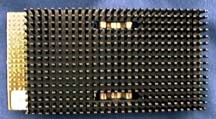 The Power Booster G3 366 came in an antistatic bag held firmly in clear plastic film in a heavy-duty box with a colorful cover. Also included were a manual and a registration card.
The ZIF CPU card, shown top and bottom in the two photos at right, is cleanly designed and well made. ZIF cards are much smaller (about 2" by 4") than the usual cards that fit into the daughtercard slot of a PCI PowerMac or clone. Heat from the G3 CPU is dissipated by a modest aluminum heat sink (black) which covers the IBM PowerPC 366 MHz CPU and the two backside cache chips. The heat sink is held on by two smallish clips so reasonable care must be taken to handle the card by its edges and to avoid pressing on or pulling on the heat sink in any way. The many gold pins that fit into the ZIF connector on the PowerMac G3 can be seen at left in the lower photo at right of the bottom side of the card. The card sits parallel to the motherboard rather than upright.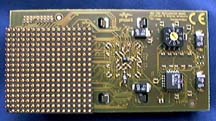
The Power Booster G3 366 has an IBM 366 MHz PowerPC 750 (G3) CPU. It has 1 MB of backside cache (double that in the beige PowerMac G3's) running at one-half the speed of the CPU (same as in the beige PowerMac G3's).
The Power Booster G3 366 has one means to optimize its performance. There is a dial switch with nine different settings shown at right on the upper right part of the card. The dial on the Power Booster G3 366 allows the selection of one of several ratios of CPU clock speed to system bus speed. The bus clock speed remains constant at whatever the motherboard is set (e.g. 66.7 MHz for the beige PowerMac G3s) so increasing the setting simultaneously increases the CPU speed. The Power Booster G3 366 came set on Setting 4. The results from trying several of the other settings is as follows:
| Dial Setting | CPU/Bus Ratio | CPU Speed (MHz) | CPU Temperature (C) |
|---|---|---|---|
| 2 | 4.5 | 300.0 | 31 |
| 3 | 5.0 | 333.3 | 31 |
| 4 | 5.5 | 366.7 | 47 |
| 5 | 6.0 | 400.0 | 39 |
Setting 5 overclocks the G3 CPU. While the Power Booster G3 366 would boot and run at 400 MHz, it proved to be unstable in routine use. Therefore, all testing was done with the Power Booster G3 366 on setting 4, the highest stable setting. Curiously, the G3 CPU temperature reported by PowerLogix's Speedmeter v1.2 was the highest on that setting. In contrast, Speedmeter reported that the original 266 MHz CPU ran still hotter at 51 deg C.
A printed manual comes with the currently shipping product. There was no manual with the Power Booster G3 366 evaluation unit because it was still being translated into English. By publication time, however, phase 5 posted a .pdf file of the manual on its web site. The manual is a 24-page 5" by 7" black and white booklet. The first half is in German and the second half is in English. There are seven photographs illustrating very well how to install the Power Booster G3. The one-year warranty is described. Technical support and service is via phase 5's web site and e-mail but one is directed to contact the retailer for warranty issues.
Likewise, the registration card for the Power Booster G3 366 is probably similar to the one that came with the Maccelerate!750 375. It is in German and English and it is mailed to phase 5 in Oberursal, Germany. phase 5 provides a one-year warranty. Again, warranty issues are handled by the local retailer rather than phase 5 in Germany, a real convenience to purchasers.
Installation and Use
The test computer was configured the way it is normally used as follows:
- Apple Power Macintosh G3/266 Minitower
- CPU: Apple PowerPC G3 266 MHz with 512k backside L2 cache
- System bus at 66.7 MHz
- 64 MB RAM
- Graphics: ATi Rage II (4 MB SGRAM) built in graphics personality card
- Mac OS 8.5, Virtual Memory on at 1 MB, no Libmoto, Disk Cache at 2 MB
Installation of the Power Booster G3 366 ZIF card was easy, although different than the usual CPU daughter cards that use the processor card slot (some use the L2 cache slot instead).
The PowerMac G3 minitower case opened easily by:
- removing the power cord and monitor cord,
- using the green latch to release the side door,
- laying the case on its side, unlatching the top part of the minitower with the power supply and
- laying it open.
The original 266 MHz CPU ZIF card has a silver heat sink with a wire attached to the motherboard.
Removing the original CPU entailed six steps:
- attaching an antistatic strap from your wrist to the metal chassis,
- removing the screw holding the wire to the motherboard,
- removing the clip holding down the heat sink,
- lifting out the heat sink,
- lifting a locking lever on the left side (when looking from the front) of the CPU card and
- easily lifting the CPU card out of its multi-pinned socket.
Inserting the Power Booster G3 366 ZIF card simply involved:
- aligning the card's connector pins with the motherboard's connector holes,
- pressing the card down very easily and
- pressing the locking lever back down.
Before closing up the computer's case, attach the power and monitor cords and check to make sure that the computer boots up, especially when trying different settings. Changing settings requires the removal of the Power Booster G3 366 because the dial switch is on its underside. This is a bit more complicated than just lifting a CPU daughtercard out and pushing a new one in but the ZIF card itself is much easier to press into the slot.
MacBench 4.0 was used for the speed test comparisons instead of MacBench 5.0 because 5.0 crashes too frequently on several of my computers and won't even boot on my PowerBase 180. The famous BYTEMark (DR3) speed tests were also run. The Walker Atrium spin minimum frames per second tests the handling of QuickTime 3D. Finally, the time in minutes and seconds were recorded to rotate 90 degrees a 5000x4000 pixel photo in Adobe PhotoDeluxe. Here are the results:
| Test |
phase 5
Power Booster G3 366/183/1 MB |
Apple
PowerMac G3 266/130/512 K |
| MacBench 4.0 Processor | 1274 | 868 |
| MacBench 4.0 Floating point | 914 | 664 |
| MacBench 4.0 Graphics | 858 | 700 |
| BYTEmark Processor | 12.2 | 8.8 |
| BYTEmark Floating point | 8.0 | 5.8 |
| Walker Atrium Spin (min. frames/sec) | 16 | 14 |
| Rotate Photo File (min:sec) | 3:23 | 3:34 |
The Power Booster G3 366 tested on the order of 24-47% faster than the original 266 MHz G3 CPU in the speed tests. This is as expected for a CPU that has a 38% higher clock speed. When rotating the large photo, the Power Booster G3 366 was only 5% faster. However, this minimal improvement actually demonstrates that a lack of RAM and a fast graphics accelerator are speed bottlenecks for graphics despite CPU speed. A substantial improvement would be expected with more physical RAM than 64 MB in the test computer.
MacBench 5.0 was run to compare with processor scores posted for the new blue PowerMac G3/350. The Power Booster G3 366 scored 1214 while the new blue PowerMac G3/350 scored 1133. The Power Booster G3 366's score is higher than just it's 5% increase in CPU speed.
Conclusions
phase 5's Power Booster G3 366 is an excellent G3 CPU ZIF card for Apple PowerMac G3s, especially those with 233 MHz or 266 MHz G3 processors that want or need a significant speed boost to equal or even better Apple's new blue PowerMac Pro G3's. However, one must remember that speed, particularly with graphics, is not only dependent on the CPU speed. To get the most out of the CPU while working with graphics also requires a lot of RAM, a fast graphics accelerator and a fast hard drive. The new blue PowerMac Pro G3's also have a 100 MHz system bus while the older beige PowerMac G3s have a 67 MHz system bus and this may make a difference with some applications. Still, this is a very fast G3 CPU card that is made for those who want to install the second fastest G3 CPU (the first being 400 MHz) in their PowerMac G3 and have it run absolutely stable. In addition, there are settings available to try for improved performance. The Power Booster G3 366 normally retails for $814.95 at The Software Hut. Checking the latest MacMall catalogue reveals that four competing 366 MHz G3 ZIF cards range from $999.99 to $1359.99. Clearly the Power Booster G3 366 is the real value leader among its peers.
Limited Time Special for readers of this review. Mention Macs Only!'s review when ordering a Power Booster G3 366 from The Software Hut and get it for an astonishing $779.95.
Many thanks to The Software Hut for loaning the Power Booster G3 366 for this review.
Copyright © 1999 by Bill Fox
All rights reserved--no commercial use permitted without attribution.
Of course . . . . . . and I am proud to be an Evangelista! . . .
Saw something? Send a tip or a correction
The archive ran on reader tips. What did you see, where, and do you want the credit? Something wrong on this page? Say so and it gets fixed.