Review-- ATI Radeon vs 3dfx Voodoo5 Comparo
Click On Images Above! |

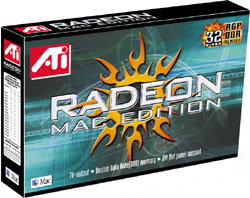
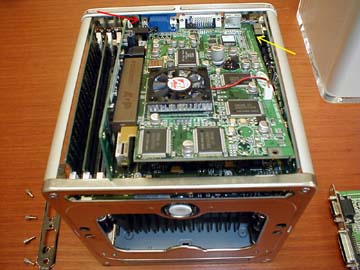
Hands-On Review: ATI Radeon vs 3dfx Voodoo5 Comparo By Bill Fox ATI, Inc. Price: $299 list, $229 street Radeon Pros: Speed, features, cost Voodoo5 Pro: Appearance Last week ATI began shipping the retail version of its latest and greatest graphics acceleration card for the Macintosh, the Radeon, in quantities. ATI's Wintel version has been out some time and a 64 MB DDR Wintel version is coming. However, the Mac Edition of the Radeon promises to be the best ever 3D graphics card for the Mac. But is it? In August 3dfx, Inc. shipped its Voodoo5 5500 PCI and we reviewed it in three parts (here, here and here). How does the Radeon compare with the Voodoo5? Well, we bought a retail version of the Radeon to see. This review covers the Radeon and compares it with the Voodoo5. What You Get The Radeon card comes with a CD, a printed User's Guide, a 15-pin VGA-to-Mac port adapter and three cables for S-video and composite video. The Voodoo5 does not include a port adapter or video cables. The Radeon (shown at right) has three video ports, a 15-pin VGA port, a DVI port (last year's digital video port for Apple's displays) and a video out port for S-video or composite TV video. The Voodoo5 comes with VGA and DVI ports, no S/composite video out. The Radeon has 32 MB of DDR (double data rate) graphics memory and the Voodoo5 has 64 MB SDR (single data rate) graphics memory. The Radeon has one graphics chip with a fan drawing power from the card and the Voodoo5 has two VSA-100 graphics chips, each with a fan that draws power from the computer's power harness. The Radeon fits in the Power Mac G4's 2xAGP slot and the Voodoo5 fits in a 33 MHz or 66 MHz PCI slot of any PCI Power Mac. Both ATI and 3dfx have stated that they will have versions that fit both AGP and PCI slots but right now the Radeon is confined to the Power Mac G4s with a Sawtooth motherboard. The Radeon has RAVE and OpenGL drivers and the Voodoo5 has RAVE, OpenGL and 3dfx's own Glide drivers. The Voodoo5 produces higher 32-bit 2D (2048x1536 vs 1920x1440) resolutions and the same maximum 32-bit 3D (1600x1200) resolution as the Radeon. There is a lot more graphics geekspeak but the Voodoo5 has 2-sample and 4-sample full scene anti-aliasing (FSAA) and the Radeon does not. FSAA smoothes the jaggies in 3D graphics. However, the Radeon supports Apple's DVD Player while the Voodoo5 does not. The CD comes with the Radeon drivers, QuickTime 4.1 and the User Guide as a PDF file. The 50-page printed manual covers how to install and use the Radeon and has a glossary and index. The only part most people might need is the 7-page video out section. The Radeon has a 5-year warranty and the Voodoo5 has a lifetime warranty. Installation and Use The Radeon card presses into the Power Mac G4's AGP slot in place of the ATI Rage 128 or Rage Pro 128 that came with it. Then the software drivers are installed from the CD. The Voodoo5, aside from going into a PCI slot, has an additional step of hooking up a power cable from the computer's power bus with an included Y-cable. We noted last week that the retail ATI Radeon does not fit into the Power Mac G4 Cube (see photo at right). It hits the small transformer at its right (upper) edge and a small circuit board at its left (lower) edge. We checked each card's performance in our 400 MHz Power Mac G4 Sawtooth (i.e. with Apple's UMA or unified motherboard architecture) with 448 MB of 2-2-2 RAM. Both cards were installed but only the drivers for the card being tested were enabled during the test. Only one monitor, a 19-in , was attached and just to card being tested, of course. For performance comparisons we used Demo 01 of Quake III Arena v1.17 to test 3D OpenGL, the DM-Peak map practice session of Unreal Tournament v436 to test RAVE (Radeon) vs Glide (Voodoo5) 3D, Walker v1.2 Sunlit Atrium spin to test QuickDraw 3D, G4TimeDemo v0.32 to test Altivec use and MacBench 5.0 Graphics (1024x768) to test 2D. Here are the results in frames per second (fps):
Quake III Arena v1.17 -- Both tests were run at 800x600 resolution and 32-bit color and with OpenGL v1.15 that came with the Radeon. The Radeon was clearly faster. It is possible that when the Voodoo5 drivers are updated by 3dfx for OpenGL 1.15 the Voodoo5 will produce a faster frame rate. However, this frame rate is about the same as achieved by the Voodoo5 card with OpenGl v1.13. The Voodoo5 was set at 2-sample anti-aliasing which provides a minor performance hit--it achieved 32.6 fps with anti-aliasing turned off. With my skills, at least, both cards were more than fast enough despite the nearly 33 per cent edge in frame rate obtained by the Radeon. Unreal Tournament v436 -- Both cards were tested at 800x600 resolution but the Voodoo5 using the Glide driver would only do 16-bit color. The Radeon will do 32-bit with the RAVE driver but the test results above are with 16-bit color to be comparable. The Radeon lost only 0.8 fps in 32-bit mode to 37.1 fps. This test is subject to some variation because the frame rate is the average frame rate obtained by playing out the Deathmatch Monastery Peak map practice session. In terms of speed, the Radeon using RAVE and the Voodoo5 using Glide are virtually identical. Walker v1.2 -- We spun the Sunlit Atrium file to determine the minimum frame rate using QuickDraw 3D for each card. The Radeon was clearly faster. G4 TimeDemo 0.32 -- This application tests the frame rate using the G4's Altivec engine. G4 TimeDemo was set to "Millions" of colors and "Amazing" quality. The Radeon was not only faster but the Voodoo5 produced terrible blocky images. MacBench 5.0 -- We used the Graphics test set at the 1024x768 resolution. The score was virtually identical for both cards. This indicates that both cards are comparable in 2D speed. The 3D performance edge goes to the Radeon. However, frame rate as measured in the tests is only one aspect of 3D graphics. The other is appearance and that is difficult to measure objectively. My subjective opinion is that the appearance edge in Quake III and Unreal Tournament goes to the Voodoo5, especially when 2-sample FSAA is enabled. I like the Voodoo5 colors better and with 2-sample FSAA the definition appears better. In Unreal Tournament, the Radeon running on RAVE with 32-bit color is very close to the Voodoo5 running on Glide with 16-bit color and 2-sample FSAA. Conclusions In this comparison, the Radeon was faster, has more features (DVD and TV video out) and costs less so the overall edge goes to the Radeon. Still, the Voodoo5 is the visual leader, at least with Quake III Arena and Unreal Tournament. . . [Go to Macs Only!'s Daily News]
MY LAWYER MADE ME POST THIS: 8-/ Apple, Apple Logos, Macintosh, and Mac OS Logos are registered trademarks of Apple Computer, Inc. All other trademarks mentioned belong to their respective owners. |


 November 13, 2000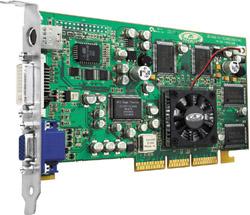
Saw something? Send a tip or a correction
The archive ran on reader tips. What did you see, where, and do you want the credit? Something wrong on this page? Say so and it gets fixed.