Hands-On Review of "Mac OS X Little Black Book"
|
Hands-On Review:
Mac OS X Little Black Book
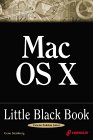
Author: Gene Steinberg The Coriolis Group, LLC Review by Bill Fox Mac OS X is Apple's new UNIX-based modern operating system for its Macintosh computers. It was released in final with little official fanfare as version 10.0 on March 24, 2001. The March final release was primarily aimed at early adopters according to Apple and it followed an earlier 6-month Public Preview release. Macs Only! posted a hands-on review of Mac OS X 10.0 when it was released. At Apple's Worldwide Developers Conference on May 21, Apple CEO Steve Jobs announced that Mac OS X would begin shipping along with Mac OS 9.1 on each Mac sold but Mac OS 9.1 would remain the default OS. While three updates to Mac OS X have been released to date, a major update is expected in mid-July to coincide with Macworld NYC 2001. At the same time and probably to much fanfare, Mac OS X will likely become the default operating system on all new Macs sold. Mac OS X is here to stay and it's about time. Apple's new operating system provides exactly what Mac users have been requesting for over five years, the stability of protected memory and the flexibility and power of multithreading and symmetric multiprocessing. Mac OS X also delivers a revamped graphic user interface that is arguably easier to use but undeniably stunningly gorgeous. It has new features and does business differently in a number of ways only partly due to its UNIX pedigree. So the transition to X is on. True to form, Apple does not provide an extensive written manual for Mac OS X. In the retail box there is, of course, a slick printed pamphlet that only covers the bare basics plus a built-in Help Center system and a built-in UNIX "on line" manual accessed through the Terminal application for those already exposed to UNIX. The details are left to third parties. A few books on Mac OS X are already available. One of the first, if not the first, is Gene Steinberg's Mac OS X Little Black Book. We purchased Gene's book in late May to read on a two week trip that included two gruelingly long airplane flights. Mac OS X Little Black Book consists of 22 chapters divided into four parts plus a glossary, index and 25 introductory pages including a table of contents. There's a fold-out Quick Reference guide to the salient features of Mac OS X inside the book's front cover. There are many screenshot illustrations and interesting parenthetical notes through out. Chapters are indexed by subject with "Immediate Solutions" page numbers and begin with an "In Brief" section that covers the subject of the chapter. The pages of each chapter have a black title box on the page edge that can be seen when the book is closed making it easy to flip from chapter to chapter. Part 1, entitled Mac OS X Arrives, has 10 chapters and consumes 192 of 456 pages in covering the basics of setting up and using Mac OS X. Mac OS X and Hardware, Part 2, has three chapters with 44 pages devoted to Mac computers in general mostly but with a couple of Mac OS X-specific information points including using Mac OS X while traveling with a PowerBook. Part 3 covers software in six chapters and 108 pages with topics ranging from Mac OS X native applications, classic applications, font management, backing up, viruses and troubleshooting. Taking Mac OS X Online, Part 4, covers web surfing, email and Apple's iTools in three chapters and 74 pages. After a few quick checks of the index and reading several specific items of particular interest we read the book from cover to cover. The book is well written and we found the organization and flow of the book to be very conducive to a full read through. In fact, we recommend doing so since it provides an excellent orientation to Mac OS X as a whole. As one reads, one encounters a few instances where a later passage or chapter is referenced for more details. One can skip forward and read them but we generally found the level of treatment of the subject to be adequate in order to wait until we got there. Mac OS X Little Black Book is also an excellent reference manual. The table of contents, chapter indexes, glossary and main index are complete and descriptive so finding information on virtually any topic is relatively easy. We like the chapter-level page edge marks. Over half of the book's content is focussed expressly on Mac OS X and the other half provides essential related information about the Mac. The depth of the book's Mac OS X content is quite good for intermediate Mac OS users making the transition in a non-networked environment. I consider myself to be an advanced Mac OS user and relatively advanced with Mac OS X since I had used the Public Preview version extensively and Mac OS X 10.0 as my primary OS since it came out March 24th. Still, I found a number of useful things that I did not already know from my own explorations with Mac OS X. The book does not delve much into the UNIX world which provides Mac OS X's foundation. For example, the book does not cover certain details that are needed for setting up Mac OS X and living on a Windows NT network, like using the UNIX-derived application Sharity to access shared file servers. The book is also not ideal for those new to the Mac OS since it assumes knowledge about Mac OS versions prior to Mac OS X and it makes frequent comparative references between them. The book came out quickly following Mac OS X 10.0 but I only found about a dozen defects, all minor. They largely consist of a few spelling errors that a spellchecker won't catch like "breaks" for "brakes", a few word omissions from sentences and a wrong figure. The book is remarkably free of mistaken references to Public Preview version features (I found only two) despite the radical changes that Apple made between the two versions. A few of the new applications/utilities that Apple included with Mac OS X 10.0 are not addressed in Chapter 14, e.g. NetInfo Manager and ProcessViewer. The intended target audience for the book as stated on the back cover is: "Any Mac user preparing to upgrade to Mac OS X" and "System administrators needing to deploy the new OS on their networks." The user level is stated to be "Intermediate to Advanced." I think it comes very close to meeting the target. Mac OS X Little Black Book is perfect for the intermediate user transitioning to Mac OS X. However, I think it falls short for systems administrators in all situations except for very simple ones because of its lack of depth with UNIX and the applications that a Mac OS X user will need to work with in a networked environment. The book, however, is still an excellent introduction to Mac OS X for a system administrator already familiar with the Mac OS. In conclusion, I enjoyed reading Mac OS X Little Black Book and learned some things. I highly recommend it to intermediate Mac users who are considering transitioning to Mac OS X or who have recently transitioned. |
Click On Images Above!
Saw something? Send a tip or a correctionThe archive ran on reader tips. What did you see, where, and do you want the credit? Something wrong on this page? Say so and it gets fixed. |