12" PowerBook G4 867 -- How Fast Is It?
|
How Fast It It?
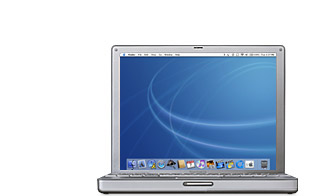
Apple 12" PowerBook G4 867 By Bill Fox Apple. Price: $1,799 Features: 12" screen, 867 MHz G4, 256 MB DDR266 RAM, NVIDIA GeForce4 420 Go graphics, 40 GB HD, slot-loading DVD/CD-RW drive ($200 SuperDrive option), 10/100 Mbps ethernet, 2 USB 1.1, 1 FireWire 400, built-in Bluetooth and ready for AirPort Extreme ($99 card option). We finally got our hands on a production model of this terrific new PowerBook G4. After we posted our first look during Macworld 2003 in San Francisco last month, we could hardly wait to really run it through its paces. We own a PowerBook 2400c but mostly we have been using a 15" 800 MHz PowerBook G4 Titanium (TiBook). We use the Powerbook 2400c under limited circumstances, like when we must work on a plane and/or carry a computer around all day for several days but do not need to do heavy graphics. Nothing has beaten the 2400c in combined portability and capability, at least not until the new 12" PowerBook G4. It may do everything our 15" TiBook does, just with a smaller screen, and might be able to replace both the 2400c and TiBook. The new 12" PowerBook G4 and 15" TiBook are fairly evenly matched. Here is a comparison of the G4 CPU/cache in the new 12" PowerBook G4 with that in our 800 MHz PowerBook G4:
The clock speed of the 12" PowerBook's CPU is 9 per cent faster than that of the 15" TiBook but the TiBook has faster and more cache. The 12" PowerBook G4 has NVIDIA GeForce4 420 Go graphics and the 15" TiBook has ATI Mobility Radeon 7500 graphics. We know little about the NVIDIA graphics and of no comparison between these two graphics systems. In part, their performance depends on how well the drivers are optimized. Both PowerBooks have 40 GB 4200 RPM Toshiba hard drives. The 12" PowerBook G4 has a more recent MK4021GAS model. The TiBook has an MK4018GAS.
The 12" PowerBook G4's screen has a hinge similar to the iBook's to minimize screen height when open, a fault of the 15" TiBook which is troublesome on an airplane, occasionally even in business or first class seating. The new hinge design appears to be much stronger than the TiBook's. We also like the new 12" PowerBook G4's battery latch. It is also similar to the iBook's with a lock that must be turned with a coin. The 15" TiBook's battery latch has been problematic for us. Grabbing the TiBook with our left hand has accidentally tripped the battery latch so often that we always try to use our right hand to pick it up or to hold it. Finally, we really like the anodized aluminum case of the new 12" PowerBook G4. It seems much sturdier and is likely to be more scratch resistent than the painted titanium of our 15" TiBook. Titanium is really cool, however, if less practical than plastic or anodized aluminum. The new 12" PowerBook G4 is easily small, light and powerful enough to replace the functionality of our PowerBook 2400c. It also overcomes the 15" TiBook's major shortcomings: screen hinges, battery latch and finish. But is it powerful enough to replace our 15" TiBook's functionality so that it's just a question of portability versus screen size? To answer that question, we ran our speed tests on a stock 12" PowerBook G4 (no Superdrive) and on our 800 MHz TiBook. Since the new 12" PowerBook G4 comes stock with 256 MB RAM, we replaced the 1 GB of RAM in our TiBook with the original 256 MB RAM chip. The new 12" PowerBook G4 uses faster (and more expensive) 266 MHz DDR RAM than the PC133 RAM in our TiBook but it can hold only 640 MB vs the 1 GB of our TiBook. The lower maximum RAM limit of the 12" PowerBook G4 may be a consideration for some heavy graphics users. Here are the test results shown as an average of three trials, each after a reboot:
Startup, as measured from the chime to the complete desktop, is faster on the 12" Powerbook G4 as is launching Classic Mode. While the CPU and graphics system play a role in these actions, the difference is probably due to the faster hard drive in the 12" model as shown by the Xbench's disk test. Shutdown time is a wash. The TiBook's G4 CPU has faster CPU cache but the 12" model's has a faster clock speed. The 12" model's CPU is 8 per cent faster according to Apple's Skidmarks GT and Altivec Fractal but only 2 per cent faster according to Xbench. In the graphics comparisons, the TiBook is much faster at scrolling the 135-page PDF file of Virtual PC 4.0's manual. The TiBook is also much faster in Xbench's Quartz graphics and User Interface (Finder) tests. The TiBook is 8 per cent faster that the 12" model at playing demanding 3D graphics as shown by the frame rate comparison using the demo in Quake III Arena v1.32 final. The 12" model excels only in Xbench's OpenGL test. In summary, the power of the new 12" Powerbook G4 is roughly equivalent to that of the 15" 800 MHz PowerBook G4. It has a slightly faster CPU and faster hard drive but a mostly slower graphics system, partly because of the graphics chip set and partly because it lacks an L3 cache. The current 867 MHz and 1 GHZ 15" TiBooks are probably noticeably faster than the 12' model because they have even faster graphics than our 800 MHz model and likely have hard drives that are as fast or faster than the 12" model. However, the performance difference for our use is not likely to be enough to make a difference. Yes, the 12" model also lacks a PCMCIA card slot, digital video port and gigabit ethernet port that the 15" PowerBooks have and it is limited to 640 MB RAM instead of 1 GB. Still, we believe that road warriors, other than video graphics professionals, will be satisfied with the 12" model's feature set and performance. It is mostly but not completely down to a question of screen size vs portability. |
Click On Images Above!
Saw something? Send a tip or a correctionThe archive ran on reader tips. What did you see, where, and do you want the credit? Something wrong on this page? Say so and it gets fixed. |
 February 3, 2003
 The new 12" Powerbook G4 is small (10.9"x8.6"), thin (1.2") and light (4.6 lbs). It is noticeably smaller than a PowerBook 2400c mainly due to it being thinner. It is even smaller and lighter than a 12" iBook. The screen, at a native resolution 1024x768 pixels, is sharp and bright--very similar to the iBook's screen--and it shames our 2400c's aging 800x600 10" screen.