Hands-On Report--The New Power Mac G5 Quad, How Fast Is It?
The Quad has a number of speed enhancements, including two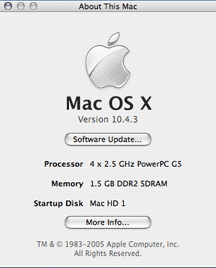 dual core 2.5GHz G5 CPUs (i.e. four cores hence the name "Quad"), faster 533MHz DDR2 memory (vs 400MHz DDR), faster PC Express (PCe) PCI slots--one 16-channel, one 8-channel and two 4-channel slots (vs PCI-X), faster Nvidia GeForce 6600 graphics card (vs ATI Radeon 9600 XT) and two gigabit ethernet ports (vs one). The graphics card occupies the 16-channel slot. It arrived in a new box design that opens on the top rather than the side along with a power cord, a DVI-VGA adapter, a USB keyboard, a USB cable extension for the keyboard, a Mighty Mouse and a black sleeve that holds the usual documentation and software DVDs.
We ordered the Quad's stock configuration that has 512MB of 533MHz DDR2 RAM and an Nvidia GeForce 6600 graphics card. We would have ordered an Nvidia GeForce 7800 GT graphics card upgrade for $350 but that option was not available when we ordered. When it finally became available as a CTO option, the Apple Store would not just add it to our order even though our Quad had not yet shipped. We would have had to cancel our order and re-order with an estimated additional delivery time of 7-9 weeks. We opted not to wait so we hope that either the 6600 will suffice, the 7800 GT will be offered as an after-market kit or ATI will release an even better graphics card for the Quad's PCe slot. The workstation level graphics card option, an Nvidia Quadro Pro FX 4500, is too steep for us at $1300 but it is a great option for those who need it.
After unpacking the Quad we popped it open and added 1GB of additional third-party 533MHz DDR2 RAM (two 512MB chips) to bring our total to 1.5GB which we have found more than adequate for our dual 2.5GHz Power Mac G5. We also added a second SATA 250GB hard drive, a Seagate, with a clone of the software on the main drive in our dual 2.5GHz Power Mac. Our Quad came with a 250GB Western Digital SATA drive.
The inside of the Quad is much the same as the dual 2.5GHz Power Mac G5. The fan assembly in front of the CPUs is a little different, i.e. the design has a more integrated look. But it pops out the same way to allow the installation of RAM on the motherboard below it.
Then we fired up our Quad attached to our Apple 30" Cinema Display via the lower (or left from the front) dual-link DVI port. The other DVI port on the Nvidia 6600 does not support the 30" display. While running the excellent Apple setup assistant, we chose to import our data from our second drive--it took roughly 15 minutes to import some 63GB of data. When we reached the desktop we noted that the Quad had a special build of Mac OS X 10.4.2 (Build 8E90) installed. To conduct our speed tests, we rebooted with the second drive as the startup drive, the same one we used for 10.4.3 speed tests on our dual 2.5GHz Power Mac G5.
So how fast is it? To determine this we ran our usual suite of speed tests on our two Power Mac G5s. The speed tests are composed of a series of "canned" benchmark applications and several so-called "real world" tests that anyone can repeat on their own Mac for comparison by following the steps that we perform.
Here are the results comparing the new Quad 2.5GHz Power Mac G5 with the previous generation dual 2.5GHz model. Both were upgraded to 1.5GB of RAM. The Quad has the stock Nvidia 6600 graphics card while the Dual has an upgraded Nvidia 6800 Ultra graphics card. Both were running Mac OS X 10.4.3 from the same hard drive:
| Test | Dual 2.5GHz Power Mac G5** |
Quad 2.5GHz Power Mac G5 |
|---|---|---|
| Mac OS X Version: |
10.4.3
|
10.4.3
|
| Benchmarks: | ||
| Altivec Fractal (GFLOPS) |
12.7
|
25.0
|
|
Cinebench 2003 - Rendering
|
645
|
1091
|
|
- OpenGL Hardware Lighting
|
1601
|
1854
|
| Let1kWindowsBloom 1.0 (sec) |
7
|
6
|
| Xbench - CPU |
243
|
243
|
| - Threading |
266
|
516
|
| - Memory |
378
|
517
|
| - Quartz Graphics |
257
|
311
|
| - OpenGL Graphics |
249
|
237
|
| - User Interface Graphics |
352
|
541
|
| - Hard Disk |
115
|
111
|
| "Real World" Tests: | ||
| Startup (sec) |
38
|
44
|
| Shutdown (sec) |
13
|
13
|
| Launch Classic Mode (sec) |
11
|
10
|
| Dup. 700 MB Folder 3600 Files (sec) |
44
|
42
|
| Scroll 142p Acrobat Reader File (sec) |
12
|
11
|
| Encode MP3 in iTunes (sec) |
52
|
52
|
| Export QT FQDV Movie in iMovie (sec) |
20
|
19
|
| Quake III Arena 1.32 (frames/sec) |
400
|
416
|
|
Halo 1.5.2 (frames/sec)
|
68
|
31
|
|
Call of Duty 1.4 (frames/sec)
|
83
|
69
|
|
Doom3 1.3 (frames/sec)
|
50
|
52
|
The Altivec Fractal test shows that the CPU power of the Quad is not quite double that of the Dual even though there are four cores rather than two. Rendering an image with Cinebench 2003, an application that uses all four cores simultaneously, is nearly 70% faster--work like this is where the Quad will shine. The Quad is also much faster at Cinebench's OpenGL Hardware Lighting test and faster at opening and closing 1000 Finder windows (Let1kWindowsBloom).
Xbench tests show that the Quad is much faster at running multiple threaded applications (threading), memory use, Quartz Graphics and User Interface Graphics. The CPUs are the same clock speed so the CPU test results are equal and the Quad and Dual used the same hard drive so those results are also more or less the same. We are only surprised that the OpenGL Graphics results are virtually the same since the Dual has a faster Nvidia 6800 Ultra graphics card.
In the everyday "Real World" tests, the Quad takes longer to start up by an average of 6 seconds. We don't know why this is but perhaps the DDR2 RAM takes longer to check. In most of the rest of the tests, other than the games, the Quad tests out at the same speed or perhaps slightly faster than the Dual.
Surprisingly, the Quad with a stock Nvidia 6600 graphics card beat the Dual with an Nvidia 6800 Ultra DDL graphics card in the Quake III Arena and Doom3 3D game tests. This is likely due to the Quad's four CPU cores. We know that Quake is a multiprocessor-aware application. Perhaps, Doom3 is also. The Quad did poorly with the Halo test, running at less than half the frame rate of the Dual, so we'd have to drop the visual quality of the test settings in Halo to play it well. The Quad also had a reduced frame rate running Call of Duty but it is still playable at our test settings. We played several hours of Call of Duty on the Quad without noticing a significant difference.
In summary, the Power Mac G5 Quad is one fast Mac, especially if one is running an application that takes advantage of multiple processors. The Finder seems much more responsive running on the Quad than the older counterpart dual 2.5GHz Power Mac G5. The Quad's fans seem quieter, both at idle and at full blast. The Quad's fans rev up all the way less frequently as well. Two other new features of the Quad are: a red light briefly shows through the front grill when the startup button is pushed and the startup chime still sounds through the Quad's front speaker when earphones are plugged into the front jack and not though the earphones, saving one's ears from getting blasted. [Bill Fox]
Saw something? Send a tip or a correction
The archive ran on reader tips. What did you see, where, and do you want the credit? Something wrong on this page? Say so and it gets fixed.