Review: 3D Overdrive Module
for the Mac Picasso 540 Graphics Accelerator
Company: Village Tronic
North American Distributor:The Software Hut
Price: $549.95 including the Mac Picasso 540 or $399.95 alone (Reduced Price 2/27/98).
Pros: Performance is excellent and software are outstanding, packaging is exceptional
Cons: Manual needs further work
Performance Rating: Excellent, a 4+ out of 5
Village
Tronic's 3D Overdrive (3DO) is a module that attaches to the Mac Picasso
540 (MP540), a graphics accelerator board for PCI Power Macintoshes. The
MP540 is the main board for a family of board modules that connect together
to yield a complete set of graphics functions in one unit. The MP540 provides
2D graphics acceleration. The Pablo module provides TV and video output.
The Paloma module provides TV and video input along with stereo audio input
and output. The 3DO board supplies super 3D graphics with its 3Dfx Voodoo
chip set to turn your PowerMac into a 3D graphics workstation and excellent
game machine. Village Tronic provided via The
Software Hut a Mac Picasso 540 and a 3D Overdrive
module for this review. The Mac Picasso 540 alone was reviewed February
16th on this page.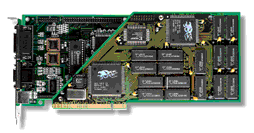
3D Overdrive Module
The 3DO (top photo to the right), like the MP540 (bottom photo), looks
well-laid out and well-constructed. In the top photograph, one can see the
3DO module with its diagonal left edge as it looks attached to the MP 540.
The 3DO has its own PCI slot connector but it is attached to the MP 540
at two points, the lower left and the upper right. The upper right connection
os a 20-pin X7 connection providing a transfer rate of 40 MB/sec. The connection
is solid and the MP540 and 3DO together take two adjacent PCI slots. The
two large 3Dfx Voodoo chips are visible. The 3DO board contains 8 MB of
graphics RAM in addition to the 4 MB that's on the MP540 and together (12
MB) they support visible resolutions up to 1600x1200 on a 21" monitor
with thousands of colors. Millions of colors are supported to 1152x870 on
a 21" monitor.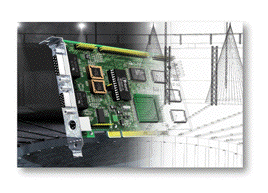 The technical features of the 3DO cover three
pages in the manual. They allow displaying 24-bit color that is double-buffered
at 30 frames per second, handling up to 13 file formats with Gouraud shading
and texture modulation, sub-pixel correction from oversampling a 4x4 matrix
and support RAVE and GLIDE for 3Dfx, etc., etc. Sounds pretty good to me!
The technical features of the 3DO cover three
pages in the manual. They allow displaying 24-bit color that is double-buffered
at 30 frames per second, handling up to 13 file formats with Gouraud shading
and texture modulation, sub-pixel correction from oversampling a 4x4 matrix
and support RAVE and GLIDE for 3Dfx, etc., etc. Sounds pretty good to me!
The 3DO like the MP540 arrived in a small 7x9x2-inch, beautifully-illustrated and colorful box--much like those containing the most recent 3D game software, a fitting analogy. The board itself was tightly packed in a bubble-wrap envelope so the card was well-protected. A 13-page manual in addition to the 72-page MP540 manual was included. While the packaging was first class in presentation and protection, the manual is a bit skimpy and still a work in progress only recently having been translated into U.S.-Canadian English. The copy I received was v1.0 and very briefly covered installation of the hardware and software plus the technical aspects of many of the features but not much else.
Test Computers
I used the MP540/3DO in both a PowerBase 180 and a PowerMac 9600 (with either a PowerLogix PowerForce G3 250 or a 604e/200 MHz CPU). In summary, the test computers are:
- PowerComputing PowerBase 180
- 180 MHz 603e CPU
- 512K L2 Cache card
- 32 MB 5v 60ns EDO RAM
- 1.2 GB Seagate IDE internal hard drive
- Mac OS 8.1 with Motorola's LibMotoSh math library
- Virtual Memory on at 1 MB
- 1024K disk cache
- Standard built in ATi graphics with 3D acceleration, 2 MB VRAM, VGA & Apple ports
- 17" RIC monitor with a resolution up to 1152x870 and a VGA connector
- Apple Power Macintosh 9600
- 200 MHz 604e CPU or 250 MHz G3 CPU accelerated to 288 MHz (PowerLogix PowerForce Ge 250/250)
- 512K L2 Cache soldered on motherboard
- 64 MB 5v 60 ns EDO RAM
- 3.2 GB Quantum Stratus internal hard drive
- Mac OS 8.1 with Motorola's LibMotoSh math library
- Virtual Memory on at 1 MB
- 1024K disk cache
- Standard video: ATi Xclaim VR Rage Pro with 4 MB VRAM, Apple port
- 17" RIC monitor with a resolution up to 1152x870 and a VGA connector
Installation
I installed the MP540/3DO in a 9600 and a PowerBase 180. First, one has to connect the 3DO module to the MP540. They connect at two points, by a small bolt and spacer at the lower left end of the diagonal edge just above the left end of the PCI connector and by a 20-pin X7 connector plug at the top right corner (visible in the lower photo above at the upper right hand corner of the MP540). Then all one has to do is unfasten the screw holding a PCI slot cover, remove the cover and press the boards into the respective adjacent PCI slots on the motherboard (9600) or riser board (PowerBase). After properly lining them up in the adjacent PCI slots, one should press the boards directly into the slots with a minimum of rocking motion. They must be seated all the way down. This was really hard in the 9600 as the slots are very stiff and I had to apply a little rocking motion to get them to seat all the way down. In the PowerBase, they just pressed right straight to the bottom with steady pressure so there is some stiffness variability among PCI slots. On the tougher slots it feels like one is going to crunch the motherboard. For the tests, the monitor was connected with the VGA port on the Mac Picasso 540.
The monitor control software called "Monitors & Picasso" (M&P) comes on a diskette with the MP 540. I received version 2.5 of the software package and v1.5.2 of M&P. The diskette contained an installer in English and one in German plus "Read Me" files in both languages. A CD comes with the 3DO. The CD has an Installer for the 3DO, A RAVE Demo that I couldn't get to work (always crashed with a Type 2 error), test software for 3DO, some .MPEG and .MOV movies, QuickDraw v1.5.3, QuickTime 2. 5, QuickTime MPEG, AMAPI a 3D modeller and a Utilities folder containing a copy of DiskCopy 6.1.3. Click the 3DO Installer and that's it, very simple.
Configuration
The Monitors & Picasso software for controlling the monitor output is marvelous. I covered it in detail in the MP540 review so I won't repeat it here. Here's a screen shot of M&P.
There is nothing else to configure to use the 3DO module with MP 540.
Use
I tried out the 3DO on two games, Quake for the Macintosh and Myth: The Fallen Lords for the Macintosh, and a 3D graphics program, Ray Dream 3D. I am not usually a gamer but both of these games and Ray Dream 3D support the 3Dfx Voodoo chip set of the 3DO. In addition, Quake supports RAVE.
Quake: The speed in frames per second (fps) at which a system configuration runs Quake is tested by using the command console. The command console is accessed by pressing the "~" key during a game. Then type in "TIMEDEMO DEMO2" and hit return. A sequence of 985 frames is played and the speed in fps is calculated. I ran these tests at a full screen resolution of 640x480 at 75 Hz on a 17" monitor with millions of colors for Quake Regular, Quake RAVE and Quake 3Dfx. Both computers ran Mac OS 8.1 with Motorola's LibMotoSH library and Virtual Memory on at 1 MB. The results for the PowerBase 180 and 9600 are:
| Computer/CPU/Video | Quake Reg. (fps) | Quake RAVE (fps) | Quake 3Dfx (fps) |
|---|---|---|---|
| PowerBase/180/Built-In | 8.9 |
n/a |
n/a |
| PowerBase/180/3DO | 8.9 |
n/a |
19.9 |
| 9600/200/ATi VR | 10.3 |
16.5 |
n/a |
| 9600/200/3DO | 10.1 |
n/a |
23.0 |
| 9600/G3/ATi VR | 15.9 |
19.7 |
n/a |
| 9600/G3/3DO | 15.4 |
n/a |
23.6 |
I could not get the 3DO to run the RAVE version of Quake. When launching Quake RAVE, I got an error message saying no RAVE card is installed and, of course, that was not so. The problem is with Quake in that its RAVE version is really an ATi Rage version which only runs on that particular video chip. All of the frame rates are playable. However, there was a substantial difference in smoothness between the 8.9 fps at the slow end and the 23.6 fps at the high end. Curiously, the built-in video in the PowerBase and the 3DO for Quake Regular were identical in these tests whereas when I just tested the MP540 against the built-in video last week, there was a significant difference which I can not explain right now. I must have had something set wrong then as I have double-checked these results.
The biggest difference was in the resolution or definition of the images. RAVE on the ATi VR card was a big leap over the regular version and 3Dfx on the 3DO was significantly better than RAVE. The 3DO combined both frame rate and definition advantages for a great experience.
Myth: I played Myth on just the 9600 with the G3 CPU. I used both the ATi Xclaim VR Rage Pro card and the 3DO for visual comparison. It should be noted that Myth does not have a RAVE version, so the comparison is not between the 3DO's 3Dfx chip set and the VR's Rage Pro chip. The VR is simply putting out software video. Despite this, both were extremely impressive, rendering very sharp images and smooth animation to the eye. However, the definition in the landscape with the 3DO using the 3Dfx chip set supported by Myth was super. The only way that I can describe it is that the green area without the 3DO still had some splochiness caused by pixel clumping but the 3DO rendered a very smooth but fuzzy green area that looked like cotton candy.
Ray Dream 3D: RD3D launched and ran well on the 3DO. The 9600/G3 with the 3DO opened and drew the countach.rds demo file in 4 seconds. Pressing the "Render" button resulted in the Countach being rendered in exactly 30 seconds for three tries. This compares with 35 seconds published by Bare Feats for the Apple Powermac G3 266. The sailboat.rds took 32 seconds to launch and draw but only 22 seconds to render using the "Render" button.
Conclusions
The Mac Picasso 540 with 3D Overdrive is an excellent high/multiple resolution 3D graphics accelerator that is designed for near workstation performance in a Macintosh. It does that job and also runs 3D games very well when compared against the fairly upscale built-in 3D accelerated video of the low end PowerComputing PowerBase PCI Mac and the ATi Xclaim VR Rage Pro in a PowerMac 9600/G3. The MP540/3DO is the very best 3D combination that I have tested . The essential MP540 retails for $199.95 and the 3DO for $399.95 more (or better yet only $549.95 when bought together as of 2/27/98). Pricewise, the MP540/3DO bundle versus the ATi VR ($249) with the additional 4 MB of RAM ($85) and Techworks Power3D combo ($199) totals just about the same. The Power3D is aimed primarily at gaming. While the MP540/3DO does extremely well with 3Dfx-enabled games, the target is also 3D model rendering at which it also does extremely well. Special Village Tronics circuitry allows the 3Dfx chips to work at much higher resolutions than the Power3D.
Copyright © 1998 by Bill
Fox.
All rights reserved--no commercial use permitted without attribution.
Of course . . .
. . . and I am proud to be an Evangelista! . . .
Saw something? Send a tip or a correction
The archive ran on reader tips. What did you see, where, and do you want the credit? Something wrong on this page? Say so and it gets fixed.