Hands-On Review of Apple's Power Mac G4 533DP
|
Hands-On Review: Power Mac G4 533DP
By Bill Fox Apple Computer. Price: $2399 list Pros: High performance, super easy and fast CD burning, high value Cons: 1 year warranty Rating: Outstanding, 4.5 out of 5 Exclamation Points: We took delivery of the fastest shipping Mac last Thursday, a Power Mac G4 533DP. Well, it's the fastest at least until the end of February when the 667 MHz an The 533 DP is also an incredible deal at just $2399 with the smaller 30 GB 5400 rpm hard drive. One can also delete the 56K modem for another $50 reduction to $2349. Just over a year ago, our first generation Power Mac G4 (AGP) single 400 MHz model with a 20 GB drive, which the 533 DP replaces, cost the same. But we're not complaining, such is the rapid evolution of personal computing and we wouldn't wish it to be any other way. The Motorola G4 processor has an AltiVec unit, or the Velocity Engine as Apple calls it, that some software like Photoshop and SoundJam MP makes use of to achieve greater performance. However, not many applications have been rewritten or written to take advantage of the AltiVec unit. Last year Apple reintroduced multiple processors in its Power Mac line but again few applications utilize multiple processors and even the latest Mac OS 9.1 does not efficiently utilize multiple processors. All that is about to change and change rapidly with the shipment of Mac OS X on March 24th. Mac OS X itself will make use of AltiVec and multiple processors. We're betting that the 533 DP will be THE Mac OS X machine until Apple begins shipping dual 667 and 733 Power Macs much later this year. What You Get The new Power Macs are identical in appearance to the previous generation from all sides but one, the rear. Here are the major standard specifications of the 533 DP:
There are both gains and losses in the new Power Macs. The increase in CPU, system bus and AGP slot speed, a CD-RW drive and an additional PCI slot (now 5 counting the AGP slot) are the major gains over the previous generation's King of Speed, the Power Mac 500 DP. There is also the new nVidia GeForce2 MX graphics card shipping standard while the ATI Radeon graphics card is an option. We have a retail Radeon that we will compare with the GeForce2 MX. The losses are DVD playback, one RAM slot (down to 3 from 4), an audio-in port and the monitor power socket. We never played a DVD movie on our 1999 Power Mac G4 400 so losing DVD playback is no loss to us. With the price of 256 MB and 512 MB RAM chips running $80+ and $170+ respectively, we won't miss the lost RAM slot. The loss of the audio-in port means we'll have to find a USB headset to use iListen or ViaVoice. Since we don't have a new Apple monitor with its ADC connector, the loss of the monitor power socket means another plug for the power strip (strips actually) and an additional power button to deal with. We think the monitor power socket loss will prove to be the most significant over time. However, clearly the gains vastly out weigh the losses. Apple provides a minimal 1 year warranty. AppleCare, an additional 2 years warranty, is offered for $249 and we recommend it if you are going to keep your Power Mac more than a year or sell it soon after a year. Set Up and Use Everything is easy to get to under the 533DP's hood. We added a 256 MB PC-133 RAM chip, an AirPort card, a 40 GB 7200 rpm Maxtor slave hard drive, an Adaptec 2930U SCSI card and 4.5 GB 7200 rpm IBM SCSI hard drive to the 533 DP. All these additions were simple and accomplished just like in other recent Power Mac generations. We did find the door to be a bit more difficult to get fully snapped shut than our 1999 Power Mac G4 which in turn was harder to fully latch than our Blue & White G3. At its best we were still left with the feeling that the 533DP's door might just drop open on its own accord. Fortunately, it has not. The new motherboard has the RAM slots in the middle, between the PCI slots and the CPUs which are moved to the rear of the top edge. The CPUs are massive, taking up on the order of 20 per cent of the motherboard area, and the heat sinks are covered with a translucent plastic cap. It's reminiscent of the early G3 processor upgrade cards that had finned heat sinks the full length of the PCI card. The 533DP came with a special edition of Mac OS 9.1 with Mac OS ROM v6.7.1. Curiously, iTunes was not factory installed. iMovie 2 was, though. After booting and running through the Setup Assistant, we transferred some 10 GB of files from the main drive of our 1999 Power Mac G4 via 100 mbps ethernet. Too bad only the new 533DP has Gigabit ethernet, a super feature but one that we wonder if we will ever get to use before we replace the 533DP at some time in the future. How Fast is It? Unfortunately, we have no way of specifically exercising the second processor, i.e. we have no multiple processor aware applications. Nevertheless, we think the extra $300 for the second 533 MHz G4 CPU will be worth it when Mac OS X arrives and new or revised applications come out over the next year. In addition, MacBench has been widely denounced for not being AltiVec aware. While this is true, MacBench still indexes speed for everything but AltiVec aware applications which are actually still all too rare. Here are the MacBench 5.0 results for the 533DP and our Power Mac G4 400SP:
*The Power Mac G4 400SP ran Mac OS 9 while the 533DP ran Mac OS 9.1, VM off The scores are not strictly comparable because they used different operating system versions but they provide a sufficient general idea. The 533DP is faster by less that the 33 per cent increase in clock speed. This is the usual case. Also as expected, the 533DP's 30 GB 5400 rpm IBM drive is slower than the 400SP's 20 GB 7200 rpm Western Digital drive. In addition, we timed how fast the 533DP opened Windows ME in Virtual PC 4.0.1 to the network login window as compared with a 450 MHz G4 Cube also running Mac OS 9.1:
The 533DP's improvement is 26 per cent, greater than the 18 per cent increase in CPU MHz speed. In fact, Windows ME functions at a perfectly reasonable speed on the 533DP and Windows 95 actually seems snappy. We'll have to wait for Mac OS X and multiple processor aware applications to see the real difference in speed that the second 533 MHz CPU adds. The GeForce2 MX vs The Radeon? The new Power Macs ship standard with a new graphics card using the Nvidia GeForce2 MX graphics chip set. ATI's Radeon graphics card is a no-cost BTO option. Nvidia makes THE graphics chip set for 3D speed, especially 3D games, in the PC world and just began supplying Apple with its GeForce2 MX chips. ATI has supplied virtually all of the graphics cards and chips for Macs for a long time. It's latest speed demon, the Radeon, was used in the Summer 2000 Power Macs and G4 Cube. In our comparative review, the Radeon beat out the only other 3D card for the Mac at the time, former 3dfx's superb Voodoo5 graphics card, in all categories but subjective visuals. The stock Nvidia card has the new Apple Display Connector and a VGA connector. The ATI card has DVI, VGA and S-Video connectors. We performed a number of tests between the stock Nvidia GeForce2 MX card and a retail version of ATI's Radeon. Here are the results:
The Radeon seems to be the better choice at this time unless all you do is play 3D games that use the OpenGL API's like Quake III Arena. However, Nvidia's performance is likely to improve as its drivers are developed. The Radeon also gets our subjective visual nod over the Nvidia in Unreal Tournament, a toss up in OpenGL. The CD-RW Drive The 533DP comes with an internal Sony CRX140E CD-RW drive and Disc Burner and iTunes software. The CD-RW drive can read CDs and write (burn) to recordable and rewritable CDs. The 533DP came with two blank CD-R's so I tried out the new burner and Apple's new iMovie-like easy software. First we made an emergency CD with Disk First Aid, TechTool, TechTool Pro and DiskWarrior. Popping in the blank CD caused Disc Burner to launch and three formats were offered: standard files, MP3 files and audio tracks. After selecting "Standard" and the CD was formatted, we dragged and dropped the applications on the CD icon and clicked the "Burn" button. Less than 2 minutes later, the CD was done. It worked in every Mac around here. Then we made an audio CD. The second blank CD-R was inserted and audio track format was selected. We opened iTunes, selected a new playlist and then dragged and dropped 19 MP3 files into iTune's window, 69 MB some 72 minutes worth. A standard CD-R holds 74 minutes but there are premium CD-R's that hold 80 minutes. Finally, we clicked on the "Burn" icon and in just over 17 minutes later the CD was done. We now have a working audio CD on the first try, a collection of 19 of our favorite golden oldies. This is fantastic since we have tried burning audio CDs with Toast and SoundJam MP on a VST USB CD-RW with little success. Conclusions We couldn't be happier with a desktop computer. The new Power Mac G4 533DP with its CD-RW drive and CD burning software is fabulous. Apple's motto for the new Power Macs is "Power to Burn." And the CD burning process couldn't have been easier. Apple has hit another ease-of-use home run for the consumer and us, too! While its speed will soon be eclipsed by the Power Mac 733SP, the 533DP is today the fastest Mac in any consumer's hands and it is fast. We expect it to be relatively faster with Mac OS X because Mac OS X directly supports symmetric multiprocessing on multiple processors. Who knows? In the near future, like next month, the 533DP may once again claim the Power Mac speed crown. In any case, we are all set to find out. Mac OS X secrets revealed right here...
|

Click On Images Above!
Saw something? Send a tip or a correctionThe archive ran on reader tips. What did you see, where, and do you want the credit? Something wrong on this page? Say so and it gets fixed. |

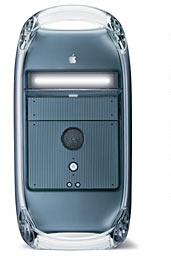 d 733 MHz Power Mac G4's are expected to begin shipping. [Apple announced the 733 was shipping as of yesterday!] Meanwhile the 533DP with two 533 MHz G4 processors is Apple's King of Speed. The 533 DP along with it single processor 466, 533, 667 and 733 MHz siblings were introduced at Macworld Expo San Francisco in January.